Jun 25, 2026
How to Tell Burnout from Depression (June 2026)
Written by:

Arthur MacWaters
Co-Founder, Legion Health

TLDR:
Burnout is tied to a specific stressor and often lifts with rest or change in circumstances.
Depression persists across all areas of life, even when stress is removed or low.
Burnout can progress into clinical depression when chronic stress goes unaddressed for months.
A clinician assessing you will look at duration, pervasiveness, and response to rest to determine which you're experiencing.
For Texas adults, Legion Health offers psychiatric evaluations with licensed clinicians to help clarify what you're dealing with.
Everything feels heavy. You can't tell if you're burnt out or depressed, and the confusion itself is exhausting. The two conditions share enough symptoms that telling them apart takes more than a checklist. Burnout is tied to a specific source of stress and tends to improve with rest. Depression persists across all areas of life, even when external pressure drops. The burnout depression difference shapes what helps. We'll walk through how to identify which one you're dealing with.
What Burnout Actually Is
Burnout is a state of chronic exhaustion caused by prolonged stress, most often tied to work or caregiving demands. The WHO classifies burnout as occupational, not a medical diagnosis, defined by three features: emotional exhaustion, growing cynicism or detachment toward your responsibilities, and a reduced sense of effectiveness (World Health Organization, 2019).
The key word is situational. Burnout is tethered to a specific source of stress. When that source eases, or when you get genuine rest, symptoms often improve. That's a meaningful distinction from what depression does, and it matters when you're trying to figure out what you're actually dealing with.
What Depression Is and How It Gets Diagnosed
Depression is a medical condition with specific DSM-5 diagnostic criteria. To meet the threshold, a person needs at least five symptoms present most of the day, nearly every day, for a minimum of two weeks (American Psychiatric Association, 2013). At least one must be either persistent depressed mood or anhedonia, the loss of interest or pleasure in activities that once felt meaningful. Other qualifying symptoms include changes in appetite or weight, disrupted sleep, fatigue, difficulty concentrating, feelings of worthlessness or guilt, and in serious cases, recurring thoughts of death.
Unlike burnout, depression does not stay confined to one area of life. It follows you across all domains, shaping how you feel at home, in relationships, and during activities that have nothing to do with work or stress. A clinician assessing you for depression will look at the full picture, including your job situation and everything beyond it, to determine whether these symptoms meet the clinical threshold for a diagnosis.
The Core Difference Between Burnout and Depression
Burnout and depression can look nearly identical from the outside, and even from the inside. Both can leave you exhausted, unmotivated, and unable to enjoy things you used to care about. The difference lies in what drives those symptoms and how they respond to rest or a change in circumstances.
Burnout is a stress response rooted in external conditions, most often chronic overwork, unrelenting pressure, or a prolonged mismatch between effort and reward. It tends to lift, at least partially, when the stressor is removed. A long vacation, a job change, or a reduction in demands can bring some relief.
Depression does not work that way. It is a clinical condition that persists regardless of what is happening around you. Rest helps temporarily, but it does not resolve the underlying problem. Someone experiencing depression may have a calm, low-stress week and still feel empty, hopeless, or unable to function.
Characteristic | Burnout | Depression |
|---|---|---|
Source | Tied to a specific stressor (work, caregiving, chronic demands) | Persists across all areas of life regardless of external circumstances |
Response to rest | Symptoms often improve when stressor is removed or reduced | Symptoms persist even during low-stress periods or after rest |
Scope | Primarily affects the area of life connected to the stressor | Affects all domains: work, relationships, hobbies, daily activities |
Duration pattern | Tends to lift when circumstances change | Lasts at least two weeks and does not resolve with external changes alone |
Classification | Occupational phenomenon (WHO ICD-11) | Clinical condition with DSM-5 diagnostic criteria |
Treatment approach | Focus on changing circumstances: reducing workload, setting boundaries, rest | Requires clinical intervention: psychotherapy, medication, or both |
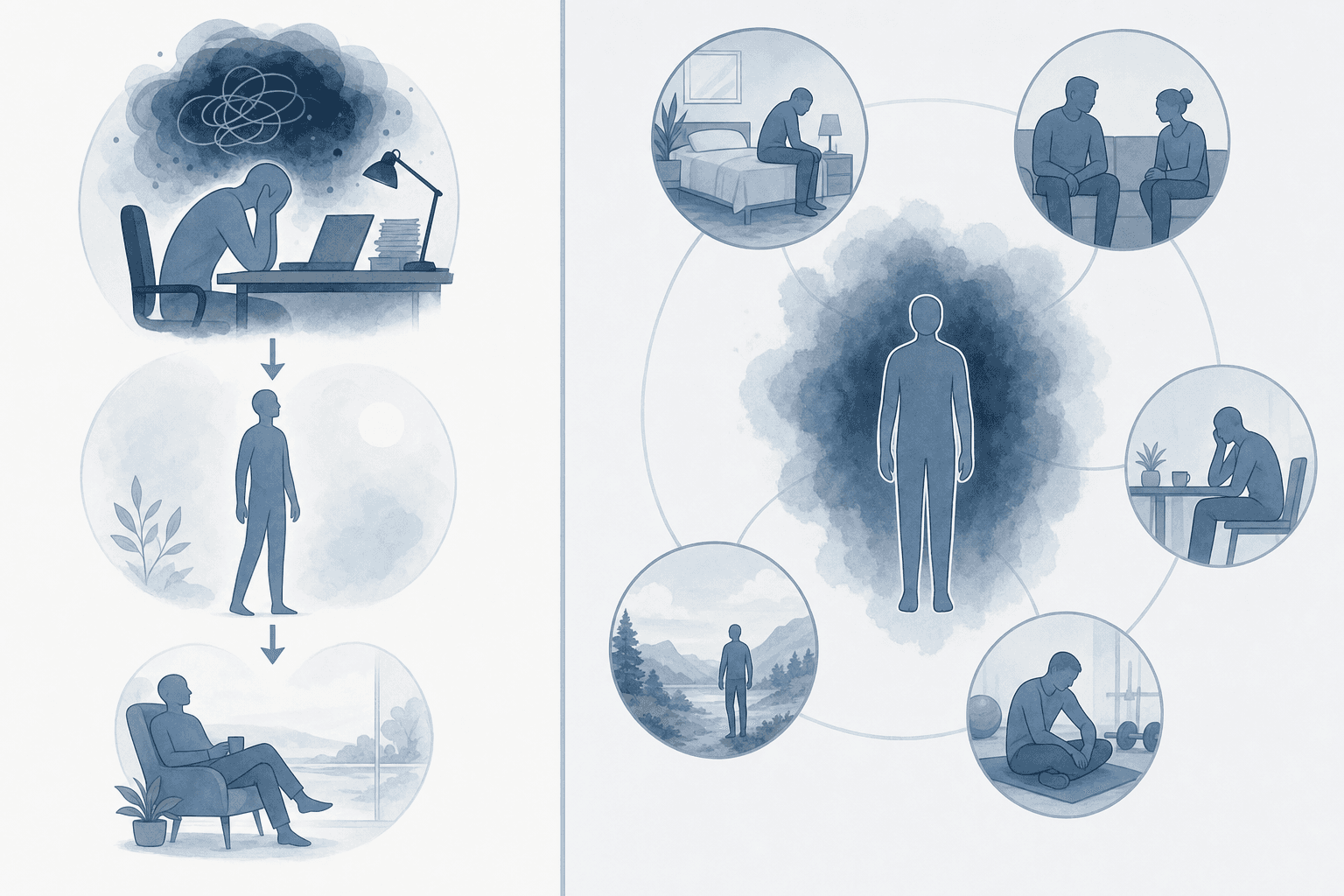
Where things get complicated
The two conditions share enough overlap that distinguishing them takes more than a checklist.
Burnout can develop into depression over time, especially when the source of stress goes unaddressed for months or years.
Depression can be triggered by a period of burnout, making the origin look situational even when the condition has become clinical.
Both involve fatigue and withdrawal, but in depression the hopelessness tends to spread beyond work into every area of life.
A clinician assessing you will look at duration, pervasiveness, and whether symptoms ease with rest to help determine which is more likely.
Symptoms That Overlap Between the Two
Fatigue, withdrawal, and difficulty concentrating show up in both burnout and depression, which is a big part of why the two are so easy to confuse. You can feel exhausted either way. You can lose interest in things you used to care about either way. You can struggle to get out of bed either way.
Some of the most common overlapping symptoms include:
Low energy that feels physical as much as mental, making even small tasks feel disproportionately hard
Reduced motivation, where starting something feels like lifting something heavy even when the task itself is simple
Difficulty focusing or following through, which can look like procrastination but often runs deeper
Social withdrawal, pulling back from friends, family, or activities without a clear reason
Disrupted sleep, whether that means sleeping too much, too little, or waking up unrefreshed
Because these symptoms overlap so heavily, a self-assessment alone rarely gives you a complete picture. A clinician assessing you for one condition will often screen for the other.
Symptoms Unique to Burnout
Burnout symptoms tend to stay tethered to a specific context, usually work, caregiving, or another sustained demand. Step away from that context and things often lift, at least a little. That situational quality is one of the clearest ways to tell the two apart.
A few patterns that show up more in burnout than in depression:
Exhaustion that feels physical and occupational without being pervasive. You may sleep adequately and still wake up dreading the day, but weekends or time off bring some relief.
Cynicism or detachment directed at your job, colleagues, or role, without the same numbness spreading into relationships or hobbies you used to care about.
A sense that your efforts no longer matter in the context where you're burning out, while other areas of life still feel meaningful.
Reduced performance at work in particular, with concentration and motivation dropping in that setting more than elsewhere.
None of these rule out depression on their own, and the two can overlap. But if your low energy and disengagement seem to follow you only into certain rooms and ease up when you leave them, burnout is worth considering as a starting point.
Symptoms Unique to Depression
Burnout tends to lift when circumstances change. Depression does not work that way.
Even after rest, a vacation, or leaving a stressful job, depression persists. The low mood, the emptiness, the loss of interest in things that once felt meaningful: these symptoms follow you across contexts instead of easing when the pressure does.
A few signs that point more toward depression than burnout:
Pervasive loss of interest or pleasure (called anhedonia) that extends beyond work into relationships, hobbies, and everyday life
Persistent feelings of worthlessness or guilt that are not tied to any specific failure or situation
Changes in sleep, appetite, or energy that remain even during low-stress periods (a clinician can help assess whether treatments like Zoloft may be appropriate for you)
Thoughts of hopelessness or, in more serious cases, thoughts of death or suicide
If any of those last points resonate, a psychiatric evaluation is worth pursuing. A clinician can assess what you are experiencing and help you understand whether what you are dealing with may be depression.
Can Burnout Lead to Depression?
Yes, burnout can lead to depression. When exhaustion and detachment go unaddressed for long enough, they can tip into something more serious. Research suggests that chronic occupational stress is a meaningful risk factor for developing a depressive episode. If you've been running on empty for months and the relief you expected from rest never comes, that may be worth paying attention to.
The Burnout-Depression Overlap Debate
Researchers have debated for decades whether burnout and depression are genuinely separate conditions or different expressions of the same underlying problem. The DSM-5 does not list burnout as a clinical diagnosis, while the WHO's ICD-11 classifies it as an occupational phenomenon instead of a medical one. That gap in classification has real consequences: it means a clinician assessing you has to work carefully to separate context, cause, and symptom pattern instead of reaching for a single label (this careful assessment approach applies to other conditions too, like borderline personality disorder). Research findings on burnout and depression overlap remain mixed, with some studies identifying meaningful differences in symptom patterns while others find substantial overlap.
Some studies suggest the two conditions share enough biological overlap, including HPA axis and inflammation, that they may exist on a continuum. Others argue the differences in onset, scope, and recovery pattern are clinically meaningful enough to treat them as distinct. Where most researchers agree is that burnout can progress into clinical depression when it goes unaddressed long enough.
When Burnout or Depression Needs Professional Help
Burnout and depression can both reach a point where self-care strategies stop being enough. Knowing when to seek a professional evaluation matters.
Some signs that it's time to talk to a clinician:
Symptoms have lasted more than two weeks and aren't improving despite rest, reduced stress, or lifestyle changes.
You're struggling to get through daily responsibilities at work, at home, or in your relationships.
You've had thoughts of hopelessness, worthlessness, or not wanting to be here anymore.
You're relying on alcohol or substances to cope.
You're no longer sure whether what you're feeling is burnout, depression, or something else entirely.
A psychiatric evaluation can help sort out what's actually going on. Burnout and depression look alike on the surface, but a clinician assessing you will ask about duration, triggers, sleep, mood patterns, and how you're functioning across different areas of life. That full picture changes what kind of support makes sense.
If you're in Texas and want to talk with a licensed psychiatric clinician, Legion Health offers psychiatric care for adults through board-certified providers.
This article is for informational purposes and is not medical advice. If you think you may have symptoms of a mental health condition, a psychiatric evaluation can help.
How Treatment Approaches Differ
Treatment for burnout focuses on changing your circumstances: reducing workload, setting limits at work, rebuilding genuine recovery time, or removing whatever is keeping the stress going. When external pressure changes, symptoms often follow.

Depression requires clinical intervention. Psychotherapy, psychiatric medication, or often both are the standard approaches, and they work independent of what is happening in your external life (for Texas adults seeking psychiatric medication management, telepsychiatry options in Dallas can provide access). A quieter job situation or a period of rest does not treat depression on its own.
That is why the distinction matters practically. Managing exhaustion through recovery makes sense for burnout. Applying that same logic to clinical depression tends to leave the underlying condition unaddressed.
Psychiatric Evaluation for Adults in Texas
If burnout has persisted for months and isn't responding to rest, or if you're noticing symptoms like persistent low mood, sleep disruption, or loss of interest in things you used to enjoy, a psychiatric evaluation can help clarify what you're dealing with.
A licensed psychiatric clinician can assess whether what you're experiencing is burnout, depression, or both, and build a care plan from there. Getting an accurate picture matters because the two conditions often call for different approaches.
Legion Health works with Texas adults and accepts most major insurance plans (coverage varies).
Final Thoughts on the Burnout and Depression Question
The overlap between burnout and depression is real, and it's not always obvious which one you're dealing with. What matters is whether symptoms ease when stress drops, or whether they persist regardless of your circumstances. If rest hasn't brought relief and you're struggling to function, a psychiatric evaluation can help sort out what's going on. See if Legion Health works for you if you're an adult in Texas.
This article is for informational purposes and is not medical advice. If you think you may have symptoms of a mental health condition, a psychiatric evaluation can help.
FAQ
Am I burnt out or depressed?
If your symptoms ease during time away from work or the stressor and return when you go back, burnout is more likely; if the exhaustion, emptiness, and loss of interest follow you everywhere regardless of rest or changes in circumstances, depression is more likely. A psychiatric evaluation can help clarify which you're dealing with and what approach makes sense.
Burnout vs depression: what's the main difference I should look for?
Burnout is tied to a specific source of stress and typically improves when that stressor is removed or reduced. Depression persists across all areas of life regardless of external circumstances, and rest alone does not resolve it.
How long should I wait before getting a psychiatric evaluation?
If symptoms have lasted more than two weeks without improving, or if you're struggling to function at work or home, a psychiatric evaluation is worth pursuing. You do not need to wait for symptoms to become severe before seeking care.
Can burnout turn into depression over time?
Yes, chronic burnout can develop into clinical depression, especially when the source of stress goes unaddressed for months or years. Research shows prolonged occupational stress is a meaningful risk factor for developing a depressive episode.
What's the fastest way to know if I need medication or just rest?
A clinician assessing you will look at how long symptoms have lasted, whether they improve with rest, and how they affect different areas of your life. That evaluation determines whether medication, lifestyle changes, or both are appropriate for your situation.
How legion health Can Help You
If you’re in perimenopause or menopause and want guidance from clinicians who specialize in women’s midlife health, book a virtual visit with Legion Health today.
Hormonal changes are at the root of many symptoms women experience in the years before and after their periods stop.
Our trained menopause specialists help you connect the dots and guide you toward safe, effective solutions.
Whether you need personalized care or a prescription-based treatment plan to manage symptoms—including brain fog, hot flashes, sleep issues, mood swings, and weight gain—we’ve got you covered. Learn more here.
We're honored to support thousands on their journeys. Here's what some have shared:
Related articles

How Depression Shows Up in the Body (June 2026)
Depression Body Symptoms | Legion Health June 2026

Depression Specialists in Arlington, TX | Molina Healthcare
Depression Care Arlington TX | Legion Health

Depression Specialists Laredo TX Oscar Health (Dec 2025)
Depression Specialists Laredo TX Oscar Health