Jun 11, 2026
Hyperfocus Explained: ADHD's Confusing Superpower (June 2026)
Written by:

Arthur MacWaters
Co-Founder, Legion Health

TLDR:
Hyperfocus is intense, involuntary concentration driven by dopamine, not choice or willpower.
It activates in response to novelty, personal interest, or urgency, but you can't control when it shows up.
Time perception stops during episodes, making it hard to exit and leaving you mentally drained.
Use external alarms, visible priority lists, and transition buffers to manage it.
If you're a Texas adult seeing this pattern, a psychiatric evaluation can help sort out what's ADHD.
When people hear ADHD, they picture scattered attention and forgotten tasks. Hyperfocus is the opposite end of that spectrum, and it catches many people off guard. Your brain locks onto something so tightly that time stops registering, interruptions don't land, and you surface hours later, wondering where the day went. It's not a superpower you can aim at your to-do list, and it's not laziness when it hijacks your afternoon on something that wasn't even important. Learning what hyperfocus is, how it connects to the way ADHD brains handle dopamine, and what you can do to manage it gives you more control over a pattern that otherwise runs on autopilot.
What is hyperfocus in ADHD?
Most people picture ADHD as an attention deficit: forgotten tasks, scattered thinking, difficulty staying on track. Hyperfocus flips that picture. It is a state of intense, sustained concentration where a person with ADHD becomes so absorbed in one activity that hours pass unnoticed and outside demands stop registering.
Researchers and clinicians have recognized hyperfocus as a common ADHD experience, even though it is not included in formal diagnostic criteria. The same brain that struggles to hold attention on a boring report can lock onto something genuinely interesting with a grip that is hard to break.
How does it differ from ordinary focus
Most people can concentrate and then shift their attention when something more important comes up. Hyperfocus is different because the transition out is where the difficulty lives.
Getting pulled into hyperfocus can happen without any conscious choice, often triggered by novelty, personal interest, or an immediate reward signal.
Leaving hyperfocus requires real effort and can feel disorienting, sometimes triggering frustration or irritability when interrupted.
Time perception goes offline during these episodes, so a person may genuinely not realize two hours have passed.
A clinician assessing ADHD will often ask about both ends of the attention spectrum, because the contrast between scattered attention in low-interest tasks and intense absorption in high-interest ones can itself be a meaningful clinical signal.
The dopamine connection: why hyperfocus happens
At its core, hyperfocus comes down to how the ADHD brain handles dopamine.
Dopamine is a neurotransmitter that plays a central role in motivation, reward, and attention. In ADHD, the brain's dopamine regulation tends to work differently, making it harder to maintain attention on tasks that feel routine or low-reward. But when something genuinely captures interest, the brain can flood with dopamine activity, and attention locks in tightly.
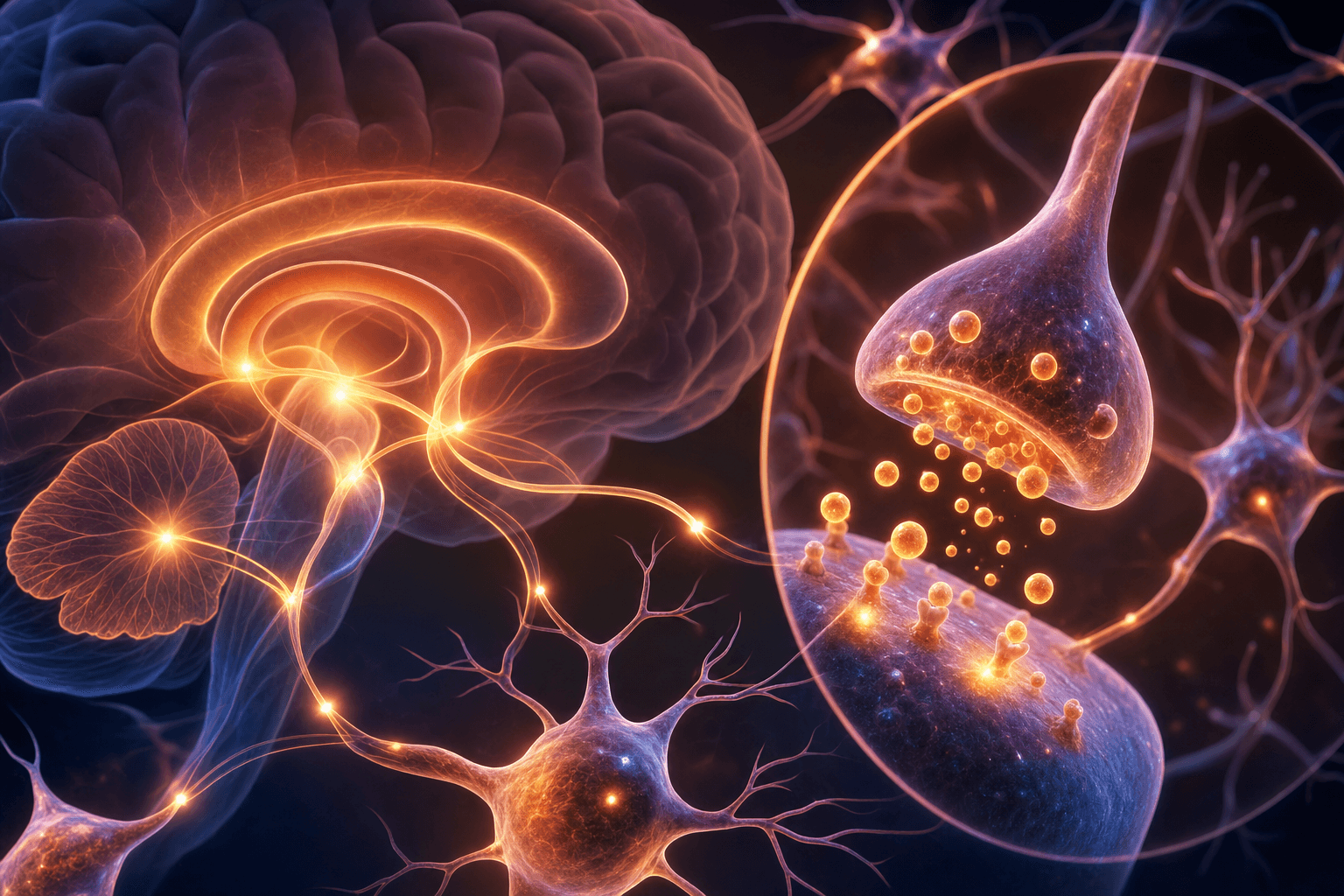
What this looks like in the brain
Research suggests that ADHD affects dopamine signaling pathways, particularly in regions tied to reward and executive function. Studies on hyperfocus and attention show that when a task triggers a strong dopamine response, such as something novel, competitive, or deeply interesting, the usual attention deficits can seem to disappear entirely.
This is why hyperfocus tends to show up in predictable contexts:
Tasks with immediate, clear feedback (video games, creative projects, sports) where the reward loop is fast and satisfying
Topics that carry personal meaning or intense curiosity, where the brain treats engagement itself as the reward
High-stakes or deadline-driven work, where urgency creates enough neurological stimulation to maintain focus
New pursuits in their early stages, before familiarity reduces the novelty-driven dopamine signal
It is worth noting that this is not a choice or a skill. The dopamine response is largely automatic, which is why people with ADHD often cannot simply decide to hyperfocus on something they find boring, no matter how hard they try.
Common triggers: what activates hyperfocus episodes
Hyperfocus does not appear out of nowhere. Certain conditions tend to invite it, and recognizing them can help you understand why your attention locks onto some things but slides right off others.
Most hyperfocus episodes share a few common activators:
High personal interest or emotional investment in a task, where the brain's reward pathways get enough dopamine stimulation to maintain deep focus without external pressure.
Novelty or a sense of challenge, since new problems or games can spike engagement quickly, especially early in the experience before repetition sets in.
Clear, immediate feedback loops, such as scoring systems, creative progress you can see, or a problem that visibly changes as you work through it.
Urgency or deadline pressure, which can push the ADHD brain into a narrowed, almost tunnel-like state of attention, though this version can be harder to exit once the pressure lifts.
Low external interruption, because a quiet or controlled environment removes the competing stimuli that might otherwise break the lock.
It is worth noting that the trigger is rarely just the task itself. The emotional state you bring to it matters too. Stress, anxiety, or a strong need to avoid something else can all push the brain toward hyperfocus as a form of escape.
When hyperfocus works: productivity and creative advantages
When conditions align, hyperfocus can be genuinely productive. Many people with ADHD describe finishing complex projects in a single session, absorbing dense material faster than they thought possible, or reaching a state of creative output that feels natural to keep going.
A few patterns tend to show up when hyperfocus works in someone's favor:
Tasks that connect to genuine curiosity or personal meaning hold attention without requiring willpower, so the work itself becomes the reward instead of something to push through.
Creative or technical work with clear feedback loops (writing, coding, drawing, music) provides the brain with the stimulation it needs to stay engaged.
Time pressure or novelty can act as a natural on-ramp, helping someone enter a focused state more quickly than they would under ordinary conditions.
The catch is that these advantages are real but unpredictable. Hyperfocus shows up on its own schedule, often on tasks that feel interesting instead of tasks that are actually due. That gap between where hyperfocus lands and where it would be most useful is something many people with ADHD spend a lot of energy trying to manage.
When hyperfocus backfires: the hidden costs
Hyperfocus can work against you just as often as it works for you. The same intensity that lets someone code for eight hours straight can also mean forgetting to eat, missing a deadline on something else entirely, or staying up until 3 a.m. on a project that felt urgent but wasn't.

A few patterns tend to show up repeatedly:
Time blindness gets worse during hyperfocus episodes. Hours disappear without any sense of time passing, leaving the rest of the day's responsibilities in ruins.
The crash afterward is real. Once the hyperfocus ends, many people with ADHD describe feeling mentally depleted, irritable, or completely unmotivated, sometimes for hours.
It's selective, not controllable. Hyperfocus tends to attach to what's stimulating, not what's important. That distinction causes real problems at work, in school, and in relationships.
Other people often misread it. Someone who can hyperfocus on video games but struggles to focus on work may be labeled lazy or as choosing not to try, which adds unnecessary shame to an already frustrating experience.
None of this suggests hyperfocus is a flaw to fix. It means the experience is more complicated than the "ADHD superpower" framing suggests, and understanding the costs is part of understanding the whole picture.
Hyperfocus across conditions: ADHD, autism, and OCD
Intense focus appears in ADHD, autism, and OCD, but the underlying experiences differ in ways that matter for getting the right support.
In autism, deep absorption in specific interests tends to be more consistent and more deliberately accessible. Many autistic people can engage that focus with some intentionality, returning to it in a way that feels like a reliable strength.
ADHD hyperfocus does not work that way. It follows dopamine conditions, not intention, which is why it shows up on the wrong task at the wrong time.
Condition | What drives the intense focus | How controllable is it | What it feels like when it happens |
|---|---|---|---|
ADHD hyperfocus | Dopamine response to novelty, personal interest, or immediate reward signals | Appears unpredictably without conscious choice and exits with real effort | Absorbed and pleasurable during the episode, then mentally draining afterward |
Autism deep focus | Consistent personal interest in specific topics that remain engaging over time | Can be accessed with some intentionality and feels like a reliable strength | Grounding and satisfying, often chosen deliberately for comfort or mastery |
OCD preoccupation | Anxiety and fear about a specific thought or concern that feels threatening | Feels involuntary and compulsive, with difficulty disengaging even when desired | Distressing and driven by need to reduce anxiety, not rewarding or pleasurable |
OCD involves preoccupation driven by anxiety. Attention returns to a feared thought or compulsion not because the activity is rewarding, but because disengaging feels threatening. That pull is closer to a compulsion loop than to the absorbed, almost pleasurable quality of ADHD hyperfocus.
Knowing the difference
These distinctions are worth understanding if you are trying to make sense of your own patterns. A person who can reliably access deep focus on their interests and finds it grounding may be experiencing something autistic in nature. A person whose attention gets stuck on something distressing and who cannot let go, even when they want to, may be dealing with OCD-related preoccupation. And a person whose deep focus appears unpredictably, often at inconvenient times, and then disappears without warning, is more likely describing ADHD hyperfocus. A clinician can help sort this out and what that means for care.
Managing hyperfocus: strategies to reclaim control
Managing hyperfocus is less about prevention and more about building guardrails around it.
A few approaches that tend to help:
Set a timer before starting any high-interest task. Your internal time sense won't alert you when two hours have passed; an external alarm will.
Keep a visible list of today's priorities nearby. When absorption pulls you deep, a written reminder of what's actually due makes the tradeoff harder to ignore.
Use external interruptions, like asking someone to check in on you at a set time. Mid-episode, other people are more reliable than your own intentions.
Build a short transition buffer between activities. Moving directly from a hyperfocus session into something demanding rarely goes well; a brief, low-demand gap can help your attention shift.
With enough environmental scaffolding, hyperfocus becomes something you can work around instead of something that quietly dismantles the rest of your day.
Getting the right diagnosis and treatment support
Recognizing hyperfocus as part of a broader ADHD picture matters when you're seeking an evaluation. A clinician who understands ADHD will look at the full range of attention patterns, including more than distractibility, because hyperfocus alongside executive function struggles can actually complicate diagnosis.
If you're an adult in Texas and these patterns feel familiar, a psychiatric evaluation can help clarify what's going on. Treatment for ADHD may include medication, behavioral strategies, or both, depending on your situation. ADHD treatment options may include stimulant or non-stimulant medications when clinically appropriate, and any prescribing involves a careful evaluation and ongoing follow-up.
Getting an accurate read on your attention patterns is a reasonable first step. A licensed psychiatric clinician can help you sort out what's worth treating and what strategies might actually fit how your brain works.
Final Thoughts on Managing Hyperfocus
Hyperfocus is part of how ADHD shows up, not a separate feature you can turn on when it would be useful. The unpredictability matters as much as the intensity. If you're trying to make sense of your own attention patterns, scheduling an evaluation with a licensed psychiatric clinician can help clarify what's going on and what treatment approaches might fit your situation.
FAQ
What is hyperfocus in ADHD?
Hyperfocus is a state of intense, sustained concentration where someone with ADHD becomes so absorbed in one activity that hours pass unnoticed and outside demands stop registering. The difficulty lies in transitioning out, which requires real effort and can feel disorienting when interrupted.
Hyperfocus vs regular focus: what's the difference?
Regular focus allows you to concentrate and then shift attention when something more important comes up. Hyperfocus locks in without conscious choice, often triggered by novelty or personal interest, and exiting requires real effort even when you want to stop. Time perception goes offline during hyperfocus episodes, so you may genuinely not realize hours have passed.
Can you control what you hyperfocus on?
No. Hyperfocus follows dopamine signals, not intention, which is why it tends to show up on tasks that feel stimulating rather than on tasks that are due. You cannot decide to hyperfocus on something boring, no matter how hard you try, because the dopamine response is largely automatic and triggered by personal interest, novelty, or immediate reward signals.
How do I manage hyperfocus when it disrupts my day?
Set a timer before starting any high-interest task, keep a visible list of your priorities nearby, and ask someone to check in on you at a set time. External interruptions work better than your own intentions during hyperfocus episodes. Build a short transition buffer between activities, instead of moving directly from a hyperfocus session into something demanding.
Should I get assessed if I experience ADHD hyperfocus?
If you recognize hyperfocus as part of a broader pattern of attention struggles, intense absorption on some tasks alongside difficulty sustaining focus on routine work, a psychiatric evaluation can help clarify what's going on. A licensed psychiatric clinician can assess the full range of attention patterns and help you understand what's worth treating and what strategies might fit how your brain works.
This article is for informational purposes and is not medical advice. If you think you may have symptoms of a mental health condition, a psychiatric evaluation can help.
We're honored to support thousands on their journeys. Here's what some have shared:

I have been seeing Blessing since June and it has been an amazing experience. She is the first provider that has actually listened to me about my symptoms and how much they are affecting my life. She is helpful and is very cautious about which medications to prescribe so that we limit side effects. Overall I could not be happier! I have sent several friends to Legion and Blessing.

Excellent service

I have had great care. The staff is always available and they are very caring. When you are dealing with the stresses of life, it is good to know there are people who understand.

My provider listens to how I’m feeling and has truly made a significant impact on my mental health, specifically anxiety! It’s greatly reduced and I had lived my whole life full of worry! Grateful!!

I’m very pleased with the ease of use to book appointment and also the quality of care. Highly recommend !

Really great experience. I got an appointment within a week and the doctor was really nice and professional and they scheduled my labs and everything in a timely manner. I was able to get them done locally and they reviewed them within the next 2 or 3 days with me over video conference. Really good experience!
Related articles

Signs of Adult ADHD You Might Be Brushing Off (June 2026)
Adult ADHD Signs You're Missing (June 2026)

Concerta vs Adderall: Two Common ADHD Medications, Compared by Mechanism (June 2026)
Concerta vs Adderall: ADHD Meds Compared (Jun 2026)

How Stimulant Medications Work: Understanding Adderall, Vyvanse, and Ritalin (June 2026)
How Stimulant Medications Work (June 2026)