Jan 29, 2026
Legion Health vs Circle Medical (April 2026)
Written by:

Arthur MacWaters
Co-Founder, Legion Health

TLDR:
Circle Medical uses primary care clinicians for mental health; Legion uses psychiatric specialists (psychiatrists and psychiatric NPs).
Legion routinely treats bipolar disorder, OCD, PTSD, and treatment-resistant cases; Circle Medical tends to refer these out.
Legion includes FDA-cleared objective ADHD testing at no extra cost and does not use one-size stimulant caps; Circle Medical keeps stricter internal dose limits and referral rules.
Both accept insurance, but Circle Medical is built around general medical care, while Legion is a virtual psychiatry clinic for Texas adults.
When you look at Circle Medical alternatives, the real question is not whose app looks nicer. It is whether the clinicians you see are generalists or psychiatric specialists, and what that means for the conditions they can safely treat. Primary care can work well for straightforward anxiety or simple ADHD, but more complex cases usually need specialty psychiatry. This guide compares Circle Medical and Legion Health on scope of care, who actually treats you, ADHD protocols, and how each clinic handles insurance so you can pick the option that matches your needs.
What is Circle Medical?
Circle Medical is a telehealth clinic built around primary care. Patients can book visits for routine medical issues, annual exams, and mental health through a mobile app, similar to seeing a family doctor online.
Care is delivered by generalist clinicians such as family medicine physicians, internists, nurse practitioners, and physician assistants. They handle broad medical needs and also prescribe for common mental health conditions when those needs fit within a primary care setting.
Key points about Circle Medical’s mental health care:
Provider type: Primary care clinicians (MDs, DOs, PAs, NPs). There are no psychiatrists listed as core staff.
Sweet spot: Mild-to-moderate anxiety or depression, and straightforward ADHD cases.
Referral posture: Patients with complex mood disorders, psychosis, or multiple failed medication trials are often referred out to psychiatric specialists instead of treated long term inside the clinic.
What Is Legion Health?
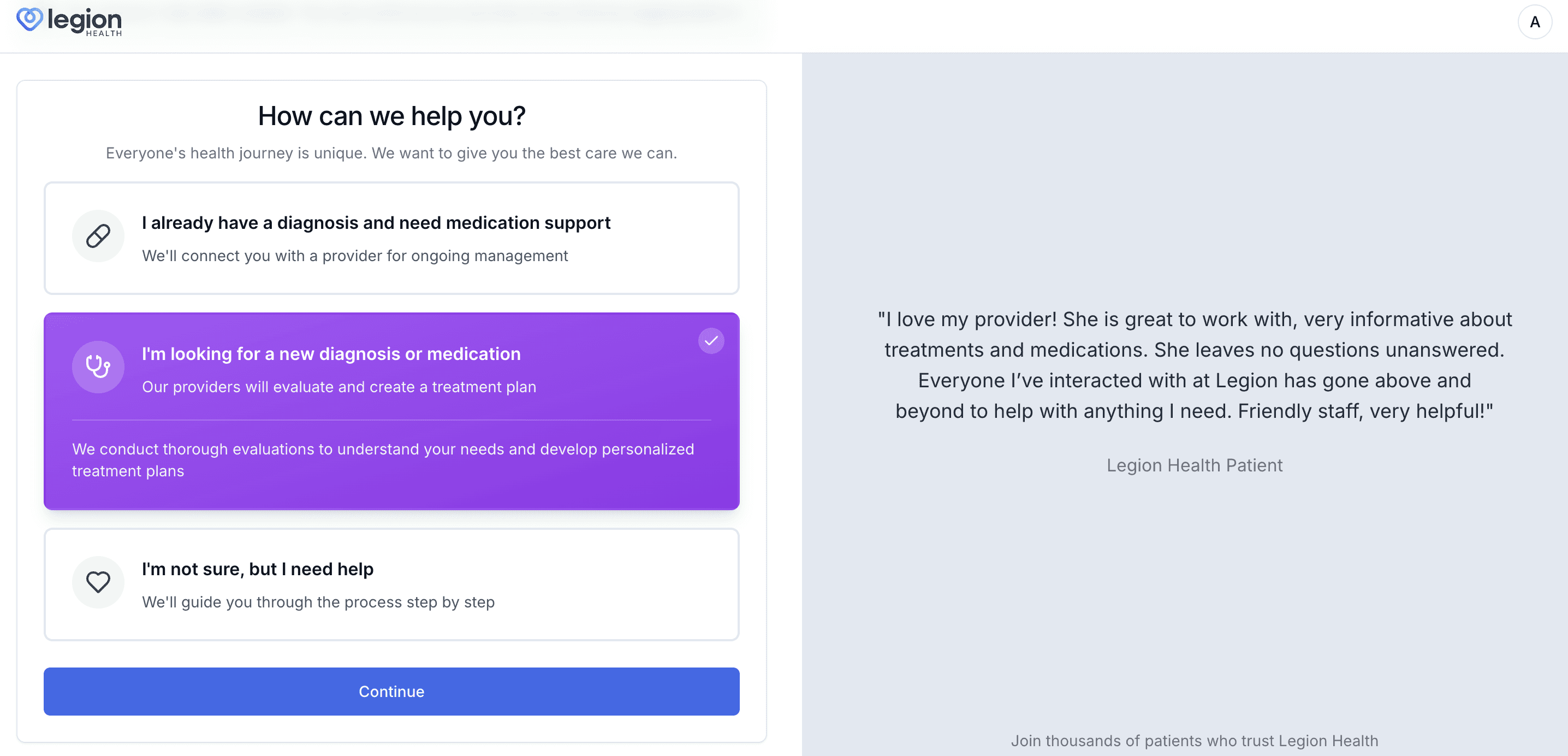
Legion Health is a virtual psychiatry clinic for adults in Texas that focuses on insurance-covered evaluations and medication management for mental health conditions. Visits are telehealth-only, so you meet with psychiatric clinicians by secure video from home. Legion's coordinated care mental health tool connects psychiatric care with primary care when needed.
Care is provided by psychiatric specialists, not primary care. Legion’s clinicians diagnose and treat conditions such as ADHD, anxiety disorders, depression, bipolar disorder, PTSD, and OCD, with ongoing follow-up. The clinic also builds structured pathways for conditions like ADHD that include objective testing.
Clinical Training and Expertise
The biggest difference between Legion Health and Circle Medical is who you sit down with and what they are trained to manage.
Circle Medical: The Primary Care Model
Circle Medical’s clinicians are trained to handle the full range of primary care issues and some mental health needs. They are often the first stop for concerns such as:
Mild depression or anxiety
Stable ADHD already on a low or mid-range dose
Brief counseling around stress and sleep
This works well when symptoms are simple and respond to first-line treatments. But because they are not running a dedicated psychiatric service, they draw firm lines around:
Complex mood disorders (for example, bipolar disorder or schizophrenia)
Situations involving psychosis or recent psychiatric hospitalization
Treatment-resistant cases (often defined as three or more failed medication trials)
In those situations, they will ask you to find a specialist outside the clinic.
Legion Health: Specialist Psychiatry
Legion Health is built as a psychiatry-only clinic. Care is delivered by psychiatric nurse practitioners and psychiatrists who focus on diagnosing and treating mental health conditions all day. This specialization matters: studies indicate that psychiatric specialists are better equipped to manage patients with complex mental health needs and multiple chronic conditions.
The team is set up to treat:
Depression, including cases where several medications have not worked well
Anxiety disorders (GAD, panic disorder, social anxiety, and others)
ADHD in adults, including complex cases with other diagnoses at the same time
Bipolar disorders that need careful mood stabilizer and medication planning
OCD, trauma, and PTSD-related symptoms
Insomnia and sleep issues tied to mental health
Legion is designed for people who often have more than one diagnosis at once, such as ADHD plus anxiety or depression. Its multi-condition psychiatry model lets one psychiatric clinician manage the full outpatient picture instead of splitting it across multiple clinics.
Conditions Treated: Who Is Best for What?
Choosing the right provider starts with knowing whether they can actually treat what you are experiencing. Because Circle Medical operates as a primary care clinic and Legion Health functions as a specialized psychiatry practice, the clinical scope differs between the two.
Circle Medical: Scope and Limits
Circle Medical typically fits patients who want primary care and light mental health support in the same place, such as:
Mild-to-moderate anxiety and depression
Uncomplicated ADHD that responds to standard doses
No history of hospitalization, mania, psychosis, or self-harm crises
Circle Medical is usually not a match if you:
Take benzodiazepines (like Xanax or Klonopin), since they tend not to prescribe these long term
Have bipolar disorder, schizophrenia, or psychotic symptoms
Have tried several medications without benefit
Need more flexible stimulant dosing for ADHD than their internal caps allow
For ADHD, Circle Medical generally keeps stimulant doses under a threshold such as 60 mg daily and refers out when patients need higher or more complex regimens.
Legion Health: Broad Outpatient Psychiatric Care
Legion Health is built to handle the full range of typical outpatient psychiatry. Because care is run by psychiatric specialists, the clinic can continue working with you even when things are more complex or have not responded to simple first-line care.
Conditions and scenarios Legion is well suited for:
Mild-to-severe anxiety and depressive disorders
ADHD with co-occurring conditions (for example, ADHD plus panic disorder or PTSD)
Bipolar disorders needing mood stabilizers and close monitoring
OCD and trauma-related conditions needing medication support
Treatment-resistant depression and ADHD where several medications have already been tried
For ADHD, Legion does not follow a rigid dose cap. Instead, dosing decisions are made case by case, based on safety, side-effect monitoring, and objective data from tools like QbCheck, which is included at no extra cost in its ADHD pathway.
Side-by-Side Scope Overview
Condition or Scenario | Circle Medical | Legion Health |
|---|---|---|
Mild Anxiety and Depression | Yes | Yes |
Uncomplicated ADHD | Yes | Yes |
Complex ADHD (High Dose or Comorbid) | No (typically capped at 60mg) | Yes (based on clinical need) |
Bipolar Disorder | No | Yes |
OCD and PTSD | No | Yes |
Treatment-Resistant Cases | No (refers out after 3 failures) | Yes |
Benzodiazepine Management | No |
ADHD Diagnosis and Treatment Approach
ADHD is a common reason people seek online care, and the approach differs between a primary care clinic and a psychiatry-only clinic.
Circle Medical: Uses standard self-report questionnaires and clinical interviews. Depth of assessment and comfort with complex ADHD differ by provider. Dose caps and referral rules are stricter.
Legion Health: Uses a defined ADHD protocol that combines detailed clinical history with QbCheck objective testing at no additional cost, plus structured safety checks and coordination with primary care when needed.
Legion’s ADHD model gives clinicians extra data to support diagnosis and to fine-tune medication plans over time instead of relying only on self-report.
Access, Follow-Up, and Reliability
A good first visit is only useful if follow-ups and refills are just as dependable.
Circle Medical: Runs on a general primary care schedule, where mental health visits share the same pool as physical complaints and annual exams. This can make follow-up availability dependent on broader clinic demand in your region.
Legion Health: Schedules are dedicated to psychiatry. Because the clinic focuses on mental health, follow-ups, medication check-ins, and dose adjustments are built into the workflow as ongoing needs versus added-on services.
Insurance Coverage and Cost
Both Circle Medical and Legion Health are insurance-friendly, but the billing categories and emphasis differ.
Circle Medical
Circle Medical accepts a range of commercial plans and usually bills visits as primary care, so your costs often follow your plan’s primary care copay structure. Patients upload insurance cards in the app to confirm benefits before booking, and uninsured patients can choose flat-rate pricing.
Circle is a good fit if you want to keep mental health care inside your general primary care budget and have relatively simple needs.
Legion Health
Legion Health is an insurance-first psychiatric clinic. It accepts all major commercial insurance plans in Texas and bills visits as specialist psychiatry. For many people, that means a standard specialist copay, similar to seeing a cardiologist or other specialist.
Upfront benefit checks so you know likely costs before your appointment
Use of insurance-covered online psychiatry as the default, with a cash-pay backup when needed
Why Legion Health is the Better Choice
Circle Medical can be a good match if your main goal is having one general clinic for physical health plus mild mental health support. For mild anxiety, simple depression, or basic ADHD maintenance, that model can be convenient.
When mental health becomes the main concern, though, or when you are dealing with bipolar disorder, complex ADHD, or multiple failed medications, specialized psychiatry usually serves you better. Legion Health is built for that reality:
It is a dedicated psychiatric clinic with board-certified psychiatric providers, not a primary care office that also prescribes SSRIs.
It is set up for people with overlapping diagnoses and complex histories who have not found relief in more basic models of care.
It includes objective ADHD testing, careful stimulant prescribing practices, and structured follow-up as part of its routine work.
If you want psychiatric care that uses your insurance, fits into a Texas schedule, and goes deeper than a quick primary care visit, Legion Health is likely a better fit than Circle Medical.
If you want a clearer plan for ADHD, mood symptoms, or multiple mental health concerns and prefer clinician-led, insurance-based care, you can see whether Legion Health is a match and schedule your first visit.
Final Thoughts on Comparing Circle Medical and Legion Health
The Circle Medical comparison mainly comes down to generalist versus specialist care. Circle Medical suits people with mild, straightforward needs who prefer to keep everything in one primary care clinic. Legion Health suits adults whose mental health is the main concern, whose symptoms are complex, or whose prior treatments have not worked as hoped.
If you are ready to move from research to action, booking a psychiatric evaluation at Legion Health is a practical next step. You can check your insurance, pick a time, and meet with a psychiatric clinician by video, often within days.
FAQs
How should I decide between Legion Health and Circle Medical for my mental health care?
If your symptoms are mild and you want one clinic for both physical and mental health, Circle Medical may work. If you have complex conditions, multiple diagnoses, or past treatment failures, Legion Health’s psychiatric specialists are better equipped to help.
What is the main difference in who actually treats you at each practice?
At Circle Medical, you see primary care clinicians who handle both physical and mental health issues. At Legion Health, you see psychiatric providers whose full focus is diagnosing and treating mental health conditions and managing psychiatric medications.
Who is Circle Medical best suited for compared to Legion Health?
Circle Medical is best for people with mild-to-moderate symptoms who like combining physical and mental health care in one primary care clinic. Legion Health is better for adults needing focused psychiatric care for ADHD, bipolar disorder, OCD, PTSD, or treatment-resistant anxiety or depression.
What happens if my ADHD treatment needs exceed what Circle Medical can provide?
Circle Medical has internal limits on stimulant dosing and clinical complexity. If your needs go beyond those limits, they will refer you to a psychiatric specialist, which means starting over with another clinic. Legion Health is designed to manage more complex ADHD care under one roof.
Does using objective ADHD testing really make a difference in my evaluation?
Yes. Objective testing like QbCheck adds measurable data on attention, impulsivity, and activity that complements your story and questionnaires. Legion Health includes this testing at no extra cost in its ADHD pathway, which can strengthen diagnosis and give a clear way to track progress over time.
How legion health Can Help You
If you’re in perimenopause or menopause and want guidance from clinicians who specialize in women’s midlife health, book a virtual visit with Legion Health today.
Hormonal changes are at the root of many symptoms women experience in the years before and after their periods stop.
Our trained menopause specialists help you connect the dots and guide you toward safe, effective solutions.
Whether you need personalized care or a prescription-based treatment plan to manage symptoms—including brain fog, hot flashes, sleep issues, mood swings, and weight gain—we’ve got you covered. Learn more here.
We're honored to support thousands on their journeys. Here's what some have shared:
Related articles

Legion Health vs One Behavioral: Which is Better? (May 2026)
Legion Health vs One Behavioral (May 2026)
One Behavioral Reviews, Pricing, and Alternatives (May 2026)
One Behavioral Reviews & Alternatives May 2026

Being Health Reviews, Pricing, and Alternatives (May 2026)
Being Health Reviews & Alternatives May 2026