Apr 12, 2026
Mindful Health Solutions Reviews, Pricing, and Alternatives (April 2026)
Written by:

Arthur MacWaters
Co-Founder, Legion Health

TLDR:
Mindful Health Solutions offers TMS and interventional psychiatry at clinics across CA, TX, and WA.
Virtual psychiatry may be faster for routine ADHD, anxiety, or depression care than interventional treatments.
TMS works for 60% of treatment-resistant depression cases after failed medication trials.
Legion Health offers virtual Texas psychiatry with FDA-cleared ADHD testing and same-week appointments.
Looking up Mindful Health Solutions reviews usually means you're weighing whether their interventional model is right for you or if you'd be better off with virtual psychiatry, which is easier to access. Their focus on TMS and Esketamine works for a specific patient profile, but if you're in Texas managing ADHD or routine depression, geographic limits and lack of objective testing can create gaps. Understanding when you need interventional care versus medication management helps you skip the wrong fit entirely.
What is Mindful Health Solutions, and How Does It Work?
Mindful Health Solutions is a specialty psychiatry group focused on interventional treatments, primarily for patients who haven't responded to standard therapies. Instead of offering general outpatient psychiatry, they've built their practice around procedures like TMS (transcranial magnetic stimulation), Esketamine nasal spray, IV Ketamine, and newer psychedelic therapies.
The organization runs 21 outpatient clinics across California, Texas, and Washington, making it one of the largest interventional psychiatry networks in the country. They were among the first to scale TMS-focused clinics in the U.S. and later added Esketamine and IV Ketamine to their care pathways.
Care is delivered by board-certified psychiatrists. The conditions they treat include treatment-resistant depression, anxiety, OCD, ADHD, bipolar disorder, and PTSD. Patients can be seen in person at one of their clinics or via telehealth, depending on location and preference.
On the insurance side, Mindful Health Solutions is in-network with Kaiser, Medicare, and most major commercial plans, which matters given the cost of interventional treatments.
Why Consider Mindful Health Solutions Alternatives?

Mindful Health Solutions is built for a specific patient profile: someone with treatment-resistant depression who hasn't responded to standard medications and needs interventional care like TMS or Esketamine. For that person, they're a reasonable option. But their model has real constraints worth knowing before you commit.
Geography is the first one. With clinics only in California, Texas, and Washington, patients elsewhere are simply out of reach. Most of their core treatments require in-person visits, so remote access isn't a workaround.
Their focus on interventional psychiatry also means routine outpatient care isn't really their strength. If you're managing ADHD, generalized anxiety, or mild-to-moderate depression, their model may not match what you actually need. For routine outpatient care, a general virtual psychiatry provider will likely be a better fit. A few other gaps worth noting:
Therapy is rarely offered alongside psychiatric care, so patients who need both will have to coordinate separate providers on their own.
Objective ADHD testing tools like QbCheck aren't a standard part of their evaluation process, which can leave diagnostic questions unanswered without objective ADHD testing.
Appointment availability and wait times vary by clinic location, which can affect how quickly you get started.
For adults who want virtual psychiatric care, quicker access, consistent insurance coverage, and objective ADHD testing built into the evaluation, a general outpatient psychiatry provider may be a better fit from the start.
Best Mindful Health Solutions Alternatives in April 2026: Legion Health
Legion Health is a Texas-based virtual psychiatry clinic serving adults statewide with insurance-first evaluations and medication management. Conditions include ADHD, anxiety, depression, bipolar disorder, PTSD, OCD, panic disorder, and insomnia, with care delivered entirely via secure video visits. Your care is led by clinicians, not software.
What they offer:
FDA-cleared QbCheck ADHD testing is included at no additional cost with ADHD evaluations
Integrated treatment for overlapping conditions, including ADHD with co-occurring anxiety or depression
Appointments typically available within days, with direct online booking and upfront insurance verification
Insurance-based care for major Texas commercial plans, plus a cash-pay option to maintain continuity if coverage changes
Good for: Texas adults who want virtual-first psychiatric care with fast access, objective ADHD testing, and predictable insurance-based pricing.
Limitations: Only serves adults who are physically in Texas, and does not provide in-house therapy, so patients who want ongoing psychotherapy need a separate therapist.
Bottom line: Legion Health is often the best fit if you live in Texas and need virtual psychiatric care with thorough ADHD evaluations and short wait times instead of interventional procedures.
Talkiatry
Talkiatry offers virtual psychiatry and medication management across more than 40 states through board-certified psychiatric providers, with therapy available as an add-on for existing patients in some markets. They operate on an insurance-only model, do not offer a cash-pay option, and do not include objective ADHD testing as part of a standard evaluation.
What they offer:
Psychiatric evaluations and medication management via telehealth in 40+ states
Initial visits are around 60 minutes, with 30-minute follow-ups in many markets
Insurance-based pricing with broad in-network coverage for commercial plans and Medicare
Good for: Patients who want psychiatrist-led virtual care across multiple states and have insurance coverage but do not need rapid access or objective ADHD testing.
Limitations: No cash-pay pathway if you lose coverage or are out-of-network, and wait times can run 2+ weeks depending on state and demand.
Bottom line: Talkiatry can work well if you’re insured, live outside Texas, and want psychiatrist-led telepsychiatry, but it isn’t optimized for fast access or structured ADHD testing.
Mindpath Health
Mindpath Health operates a large multi-state network that combines psychiatry, therapy, and interventional options such as TMS and Spravato at selected clinic locations. Care is delivered through both in-person visits and telehealth, with insurance coverage, services, and evaluation depth varying by clinic and clinician.
What they offer:
Hybrid model with local clinics plus telehealth access
Psychiatric medication management, therapy, and interventional treatments at certain sites
Insurance-based care, with details and availability depending on location
Good for: Patients who want in-person access, therapy plus psychiatry under one roof, or interventional care for treatment-resistant depression in supported states.
Limitations: New-patient wait times often run 2 to 4 weeks, and objective ADHD testing is not standardized across the network, so ADHD evaluation quality can be uneven.
Bottom line: Mindpath Health makes sense if you need a local clinic that offers both therapy and interventional options, but it’s less ideal if you focus on fast virtual access and uniform ADHD evaluation standards.Mindful Care
LifeStance Health
LifeStance Health operates a large hybrid network across more than 30 states, offering therapy and psychiatry via local clinics plus telehealth. Services, wait times, and insurance details vary by state, clinic, and individual clinician.
What they offer:
In-person and virtual visits for therapy and psychiatric medication management
Wide geographic footprint across 30+ states through local offices
Insurance-based care, often with many plans accepted, but specifics depend on location
Good for: Patients who prefer in-person therapy or psychiatric visits and live near a LifeStance clinic.
Limitations: Experience varies widely by site, ADHD evaluations are not standardized, and it can be harder to predict costs, wait times, and evaluation depth from location to location.
Bottom line: LifeStance works best if you want local, in-person mental health care and can tolerate variability between clinics, but it’s less easy than virtual-first options with consistent ADHD testing.
Feature Comparison: Mindful Health Solutions vs Top Alternatives
Each provider in this space has a genuinely different model, so the right choice depends on what you actually need. The table below maps out the key differences.
Feature | Mindful Health Solutions | Legion Health | Talkiatry | Mindpath Health | LifeStance Health |
|---|---|---|---|---|---|
Geographic coverage | CA, TX, WA (21 clinics) | Texas only (virtual) | 43 states | Multi-state | 33 states |
Care delivery | In-person + telehealth | Virtual-first | Virtual-first | In-person + telehealth | In-person + telehealth |
Primary focus | Interventional psychiatry | General outpatient psychiatry | General outpatient psychiatry | Therapy + psychiatry + interventional | Therapy + psychiatry |
Objective ADHD testing | Not standard | FDA-cleared QbCheck at no cost | Not offered | Not standard | Not uniform |
Typical wait time | Varies by location | Within days | 2+ weeks | 2-4 weeks | Varies by location |
Insurance model | Major plans accepted | All TX commercial plans | Insurance-only | Varies by provider | Varies by provider |
Cash-pay option | Available | Available | Not available | Varies | Varies |
Provider consistency | Board-certified psychiatrists | Centralized clinical team | Board-certified psychiatrists | Variable by location | Variable by location |
The table above reflects each provider's general model, but individual experiences can vary. Insurance acceptance, wait times, and provider availability all shift based on your location, plan type, and when you schedule.
If you're in Texas and want a fully virtual option with faster access, Legion Health accepts all major commercial plans in the state and typically gets patients scheduled within days. Care is led by licensed psychiatric clinicians, and ADHD evaluations include FDA-cleared QbCheck testing at no added cost.
TMS Therapy: When It Makes Sense vs When Standard Psychiatry Is Enough
TMS uses magnetic pulses to stimulate brain regions involved in mood regulation, with no surgery, anesthesia, or medication required. The FDA has approved it for major depressive disorder in patients who haven't responded to antidepressants. A typical course runs five days a week for four to six weeks, totaling roughly 30 to 36 sessions.
The response rates are real. According to research published in PMC, about 60% of people who didn't respond to other depression treatments respond to standard TMS protocols, and more than half stay in remission at six-month follow-up after stopping TMS.
That said, TMS is a commitment. Daily clinic visits over multiple weeks set a high bar, and it's most appropriate after trying multiple antidepressants without adequate improvement. For most adults managing depression, anxiety, or ADHD, standard medication management remains the first-line option and works well without that level of scheduling intensity.
Two questions worth asking before pursuing TMS
Have you tried multiple evidence-based medication options without adequate improvement?
Do your symptoms meet criteria for treatment-resistant depression, as confirmed by a clinician?
If the answer to either is no, standard outpatient psychiatry is likely where to start.
Why Legion Health is the Best Mindful Health Solutions Alternative
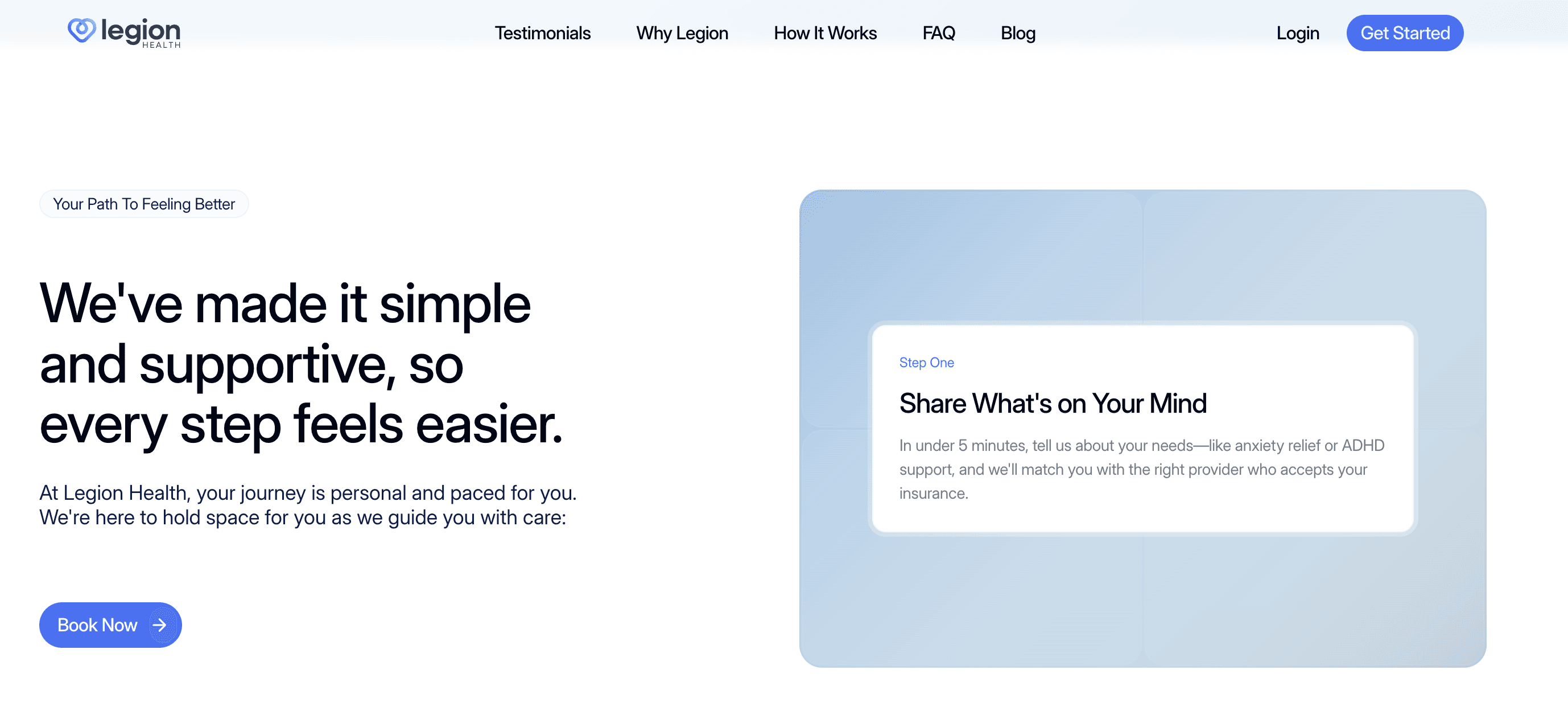
For most Texas adults, the choice comes down to finding psychiatric care that's actually accessible, instead of theoretically available.
Legion Health is virtual-first, which means no commute, no clinic waitlist, and no geographic limitation within Texas. Recent data from 2024 shows that 85.9% of psychiatrists now use video visits regularly, with 68.2% conducting more than 20% of their weekly visits via telehealth, making psychiatry the medical specialty with the highest telehealth adoption rate.
Appointments are typically available within days, and insurance verification happens upfront, so billing surprises are rare. See our detailed comparison of Legion Health vs Talkiatry to understand access differences.
Where Legion Health stands apart is in ADHD care. FDA-cleared QbCheck testing is included in every ADHD evaluation at no extra cost, giving clinicians objective data alongside the clinical interview. That matters when symptoms overlap, which they often do. ADHD paired with anxiety or depression gets treated as a single integrated picture, not two separate referrals.
Care is delivered by board-certified psychiatric nurse practitioners and licensed clinicians, not software. Your clinician leads your treatment plan from evaluation through ongoing follow-up.
If your needs go beyond standard outpatient care and you're managing treatment-resistant depression, Mindful Health Solutions or Mindpath may be worth considering for TMS. But if you want virtual psychiatric care in Texas with fast access and thorough evaluations, verify your insurance and book an evaluation to get started.
Final Thoughts on Interventional Psychiatry vs Virtual Care
For Texas adults managing ADHD, anxiety, or depression without needing procedures, Mindful Health Solutions' alternatives focused on virtual access and faster scheduling make more practical sense. Interventional treatments like TMS serve an important role for patients with treatment-resistant conditions, but standard psychiatric care remains the starting point for most people. If you want virtual psychiatry in Texas with QbCheck ADHD testing included and appointments available within days, start your evaluation to connect with a licensed clinician.
This article is for informational purposes and is not medical advice. If you think you may have symptoms of a mental health condition, a psychiatric evaluation can help.
FAQs
When should you consider looking for alternatives to Mindful Health Solutions?
If you live outside California, Texas, or Washington, you're geographically ineligible for their in-person services. Beyond that, if you need routine outpatient psychiatric care for ADHD, anxiety, or mild-to-moderate depression instead of interventional treatments like TMS, a general psychiatry provider will likely be a better match for your needs.
What should you look for when comparing virtual psychiatry providers?
Look at appointment availability, insurance acceptance in your state, whether objective testing tools like QbCheck are included for ADHD evaluations, and how they handle comorbid conditions. Also, confirm whether the provider offers both insurance-based and cash-pay options to maintain continuity of care if your coverage changes.
How do I know if I need TMS therapy or standard medication management?
TMS is typically appropriate after trying multiple antidepressants without adequate improvement and meeting criteria for treatment-resistant depression. For most adults managing depression, anxiety, or ADHD, standard medication management is the first-line option and works well without requiring daily clinic visits over several weeks.
What makes ADHD evaluations with objective testing different from standard assessments?
FDA-cleared tools like QbCheck objectively measure attention, impulsivity, and activity levels, providing clinicians with concrete data alongside the clinical interview and self-report questionnaires. This matters when symptoms overlap with anxiety or depression, helping clinicians make more accurate diagnostic and treatment decisions.
Can I get psychiatric care in Texas if I don't live near a specialty clinic?
Yes. Virtual-first providers like Legion Health serve adults across Texas regardless of location, with appointments typically available within days and insurance verification handled upfront. Care is delivered by licensed psychiatric clinicians, and you can schedule evaluations and follow-ups entirely online without needing to travel to a physical clinic.
We're honored to support thousands on their journeys. Here's what some have shared:

Really great experience. I got an appointment within a week and the doctor was really nice and professional and they scheduled my labs and everything in a timely manner. I was able to get them done locally and they reviewed them within the next 2 or 3 days with me over video conference. Really good experience!

Legion Health has been a great experience. Treat you like a person and design a custom plan to help your situation.

I’ve had a very positive and satisfying experience with Legion health and my provider, Blessing Ugbor. My needs have been met and my concerns have been addressed in a timely manner. I have been able to make contact easily and talk to real people 😊. I appreciate Legion Health for all the care and support I’ve received so far.

Really great and positive experience must try if you have been thinking about it

My first time using a teledoc. They simplified the process and my Dr. has been great. To say its been a great experience is an understatement. I highly recommend them.

They're great at communicating/meeting your needs
Related articles

Legion Health vs One Behavioral: Which is Better? (May 2026)
Legion Health vs One Behavioral (May 2026)
One Behavioral Reviews, Pricing, and Alternatives (May 2026)
One Behavioral Reviews & Alternatives May 2026

Being Health Reviews, Pricing, and Alternatives (May 2026)
Being Health Reviews & Alternatives May 2026