Feb 17, 2026
Innerwell Reviews, Pricing, and Alternatives (February 2026)
Written by:

Yash M. Patel
Co-Founder & CEO, Legion Health

TLDR:
Innerwell provides at‑home ketamine therapy for treatment‑resistant depression, anxiety, and PTSD in a limited number of states.
Insurance is only accepted with select plans in California and New York; most people elsewhere pay out of pocket for multi‑month ketamine programs.
Every ketamine session requires a trip sitter, which can be difficult to arrange on a regular basis.
Legion Health offers insurance‑based virtual psychiatry for a wider range of conditions, without ketamine requirements or trip sitter logistics.
When you search for Innerwell reviews and pricing, you are usually trying to decide if at‑home ketamine therapy is realistic for your life. Innerwell offers ketamine treatment for depression, anxiety, and PTSD through virtual care, but cost, insurance limits, and logistics can make it hard to use. Insurance is only accepted in California and New York with a short list of plans; in most other places, you pay several hundred dollars a month out of pocket. You also need a trip sitter present for every session, which can be difficult to arrange. This guide explains what Innerwell offers, what treatment typically costs, and which psychiatric care alternatives may be a better fit if you want a broader set of options.
What is Innerwell and How Does it Work?
Innerwell is a telehealth service that provides at‑home ketamine‑assisted treatment for people with difficult‑to‑treat mental health conditions. Patients receive care from licensed clinicians and therapists through virtual visits, and oral ketamine tablets are sent to the home under a structured plan.
The service focuses on depression, anxiety, PTSD, and related conditions that have not improved with standard approaches, such as typical antidepressants or medications like propranolol for anxiety. Patients must have a trip sitter present during each dosing session, and an internal tool uses factors such as weight, history, and comfort level to help clinicians determine dose ranges. For people who want care for anxiety and depression without ketamine, more traditional online psychiatry services may be a better fit.
Innerwell typically offers a shorter program with about 8 doses for mild to moderate symptoms and a longer course with up to 24 doses for more severe or persistent problems. During treatment, patients meet with clinicians several times and can use an online portal with exercises and guided content between sessions. The service is active in multiple states but currently accepts insurance only in California and New York for specific plans, including Aetna, Blue Shield of California, Anthem Blue Cross, UnitedHealthcare, and Magellan.
Why Consider Innerwell Alternatives?
Innerwell can make sense for people who have tried standard medications and therapy without improvement and are ready to consider ketamine under close supervision. Still, there are clear reasons many people look at Innerwell alternatives.
Insurance and cost: Coverage is limited to California and New York for certain insurers. Many others pay out of pocket, often in the range of $ 77 to $ 154 per week for about 3 months, which adds up quickly.
Trip sitter requirement: Every dosing session requires another adult to be present, which is difficult for people who live alone, have limited support, or work irregular hours.
Narrow focus: Innerwell focuses on ketamine for a small set of conditions. If you need ADHD care, bipolar treatment, or long‑term medication management beyond ketamine, you will still need a psychiatric clinic.
If you want care that works with your insurance, does not require a sitter, and can treat more than one diagnosis, it is worth comparing Innerwell with broader psychiatry services. As of November 2025, 23 states have implemented telehealth payment parity requiring insurers to reimburse virtual care at the same rate as in-person visits, making insurance-based telepsychiatry increasingly accessible.
Legion Health (Best Overall Alternative)
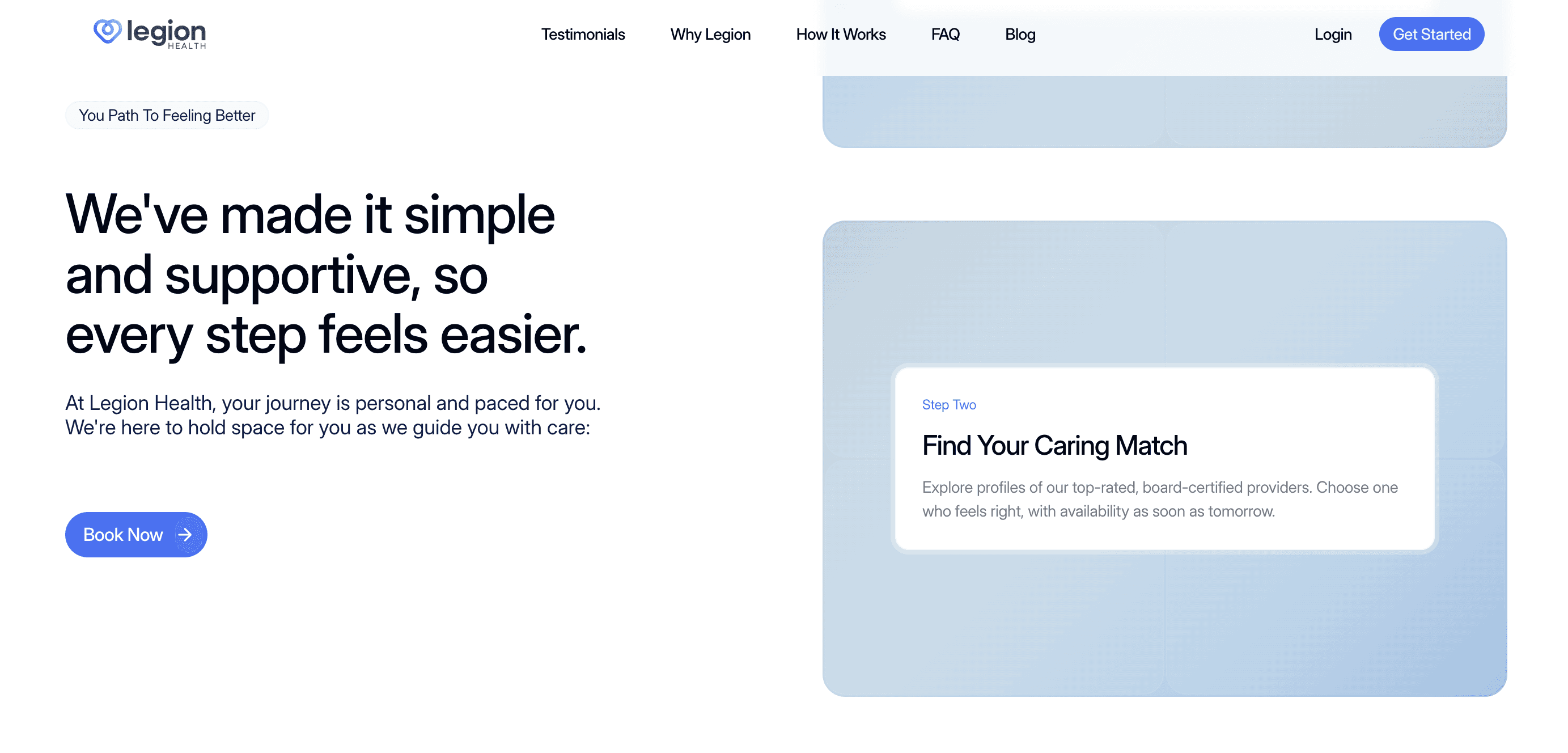
Legion Health is a virtual psychiatry clinic that treats depression, anxiety, ADHD, bipolar disorder, OCD, PTSD, and other conditions using insurance‑based care. Licensed psychiatric clinicians provide evaluations and medication management through secure video visits, with appointments often available within days in Texas.
What they offer:
Insurance‑based virtual psychiatry with major Texas plans, usually at a specialist‑level copay instead of high weekly fees.
Treatment for multiple conditions, including ADHD and mood or anxiety disorders, in one integrated plan.
Medication options that include both standard and some controlled medications when they are safe and appropriate, with careful monitoring.
Good for: People who want broad psychiatric care that works with their insurance and does not rely on ketamine as the main tool.
Limitation: Currently serves patients located in Texas, so it is not an option if you live elsewhere.
Bottom line: If you are in Texas and want virtual psychiatry that covers depression, anxiety, ADHD, and more with insurance, Legion Health is often the most practical Innerwell alternative.
Cerebral
Cerebral is an online mental health service that offers therapy and psychiatric medication visits in many U.S. states. The company treats anxiety, depression, ADHD, insomnia, and related conditions through video appointments and in‑app messaging.
What they offer:
Therapy and medication visits through an app with messaging between sessions.
Insurance relationships with several large plans, sometimes with copays around the cost of a typical office specialist visit.
Wide geographic reach compared with smaller ketamine‑focused services.
Good for: People who want app‑based care that covers common conditions like anxiety and depression, and do not need ketamine.
Limitation: After regulatory scrutiny, Cerebral no longer prescribes many controlled substances, which limits options for conditions such as ADHD that sometimes need stimulants.
Bottom line: Cerebral can be a reasonable alternative if you want therapy and medication in many states and prefer an app‑heavy experience, but for Texas residents who need ADHD or more flexible prescribing, Legion Health is often a better fit.
Lavender
Lavender is a virtual practice that offers psychiatry and therapy together through an insurance‑based model. Patients see psychiatric nurse practitioners for both medication management and supportive therapy in one place.
What they offer:
Integrated therapy and medication visits via telehealth.
Insurance coverage with several large plans in supported states.
Focus on human, nurse‑led care for anxiety, depression, ADHD, and related concerns.
Good for: People who want combined therapy and medication visits in a single clinic and live in a state where Lavender is active and in‑network.
Limitation: Lavender does not offer ketamine or intensive treatment‑resistant programs, and state coverage is limited compared with national services.
Bottom line: Lavender is a strong choice if you want integrated therapy and medication in selected states; if you need broader access in Texas with ADHD tools and multi‑condition psychiatry, Legion Health is generally more suitable.
Innerwell (Ketamine‑Focused Option)
Innerwell itself is best viewed as a niche option in this list. It focuses on at‑home ketamine therapy for people with depression, anxiety, and PTSD who have not responded to standard care.
What they offer:
At‑home ketamine dosing with clinician oversight for certain mood and trauma‑related conditions.
Virtual visits plus access to online content aimed at helping patients process their experiences.
Program tiers with different numbers of doses over several months.
Good for: People who have already tried standard medications and therapy and are now considering ketamine under clinical supervision, and who can manage both the cost and the sitter requirement.
Limitation: Limited insurance acceptance, high out‑of‑pocket costs in most states, a required trip sitter for each session, and a treatment focus that does not replace routine psychiatric care for other diagnoses.
Bottom line: Innerwell can be the right tool for a small group of patients, but often needs to be paired with a separate psychiatry clinic; many people are better served by an insurance‑based psychiatric service that can adjust medications over time.
Feature Comparison: Innerwell vs Top Alternatives
Feature | Innerwell | Legion Health | Cerebral | Lavender | Feature |
|---|---|---|---|---|---|
Main treatment | At‑home ketamine treatment | Psychiatric evaluations and medication management | Therapy plus medication via app | Therapy plus medication via telehealth | Main treatment |
Conditions focused on | Treatment‑resistant depression, anxiety, PTSD | ADHD, depression, anxiety, bipolar, OCD, PTSD, and more | Depression, anxiety, ADHD, insomnia, some bipolar | Depression, anxiety, ADHD, sleep concerns | Conditions focused on |
Insurance | Limited acceptance with select plans in CA and NY | Most major Texas plans | Several large plans in many states | Several large plans in supported states | Insurance |
Patient payment pattern | Most people pay out of pocket for multi‑month ketamine programs | Insurance‑based visits with typical specialist cost‑sharing | Mix of copays and membership‑style plans | Insurance‑based visits with standard cost‑sharing | Patient payment pattern |
Trip sitter | Required for every ketamine session | Not required | Not required | Not required | Trip sitter |
Geographic reach | Multiple states, ketamine‑only focus | Texas | Many U.S. states | Selected states | Geographic reach |
Care scope | Ketamine‑centered care for a narrow set of diagnoses | Broad psychiatric care for multiple conditions | Broad but more limited with controlled substances after policy changes | Broad, with therapy and medications but no ketamine | Care scope |
Why Legion Health is the Best Innerwell Alternative
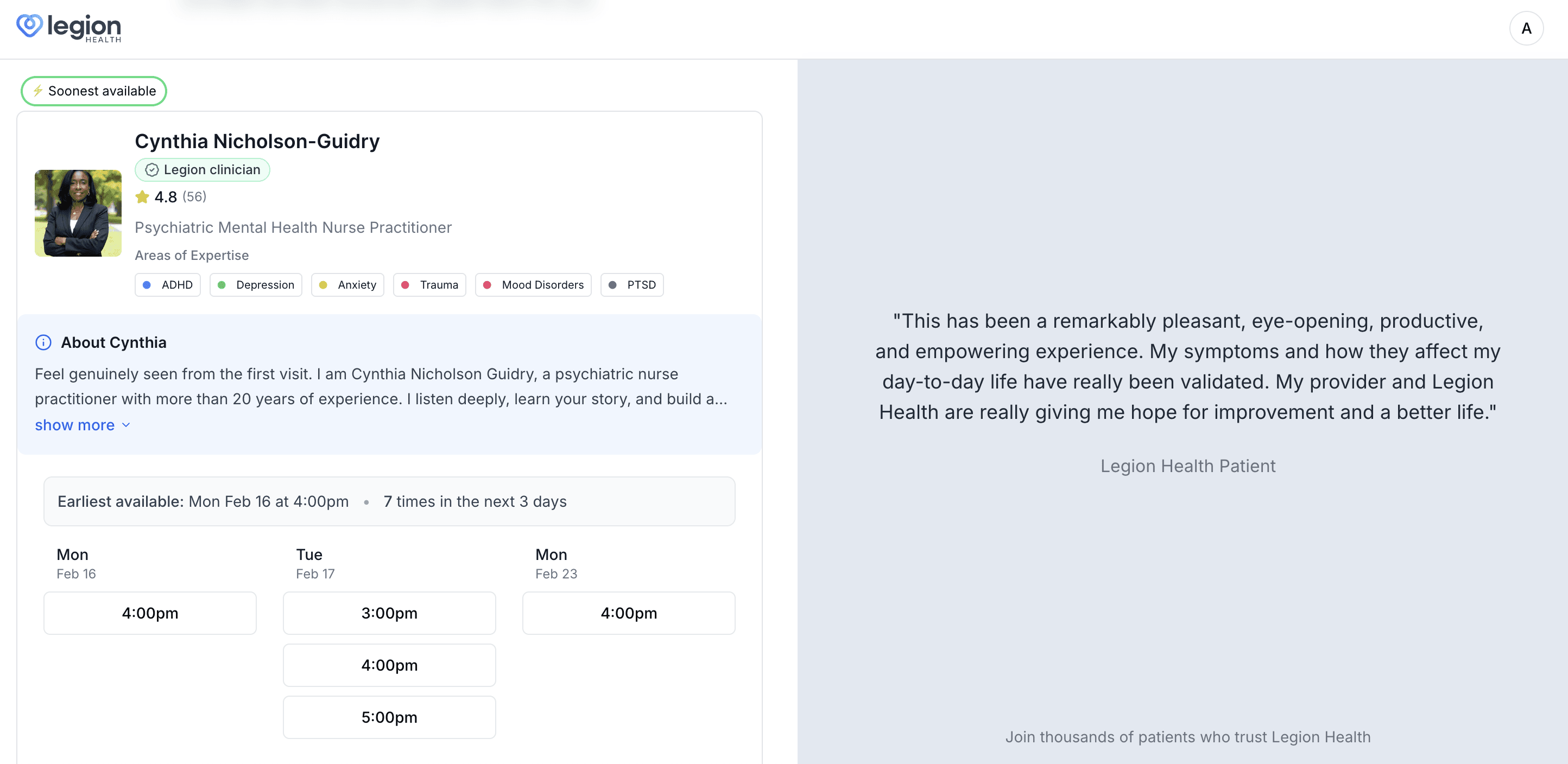
Legion Health solves many of the issues that drive people to seek Innerwell alternatives. Instead of cash‑only ketamine, you get insurance‑based psychiatric care that can include standard medications for depression and anxiety, ADHD treatment, and support for several conditions at the same ti
Most patients pay copays closer to typical office visit costs, not over $100 per week. For comparison, ADHD treatment averages $14,000 annually per adult when paying out of pocket, with medications alone costing $250-$400 monthly without insurance versus just $10-$50 with coverage.
week. You do not need a trip sitter, you are not limited to ketamine, and you can build a long‑term relationship with a psychiatric clinician who adjusts your plan as your life changes.
If ketamine is ever considered, it can be part of a broader conversation about safety, other options, and what fits your history. For many people in Texas, that makes Legion Health a more flexible and sustainable choice than Innerwell as a stand‑alone ketamine service.
Final Thoughts on Ketamine Therapy Services
Innerwell reviews can be helpful if you are looking for at‑home ketamine therapy, but cost, limited insurance coverage, and the need for a trip sitter mean it will only work for a small group of people. Many patients want something easier to maintain, with coverage for more conditions and medications.
If you are looking at Innerwell alternatives because of price, geography, or the narrow treatment focus, insurance‑based psychiatry offers a wider range. With clinics like Legion Health, you can work on depression, anxiety, ADHD, and other concerns through evaluations, medication management, and careful follow‑up without the logistics of at‑home ketamine sessions. If that sounds closer to what you need, a psychiatric evaluation is a good next step to talk through your options.
FAQs
Why would someone look for alternatives to Innerwell?
Innerwell accepts insurance only in a small number of cases and states, and many people elsewhere pay fully out of pocket for multi‑month ketamine programs. The service also requires a trip sitter for every session and is available in only a limited number of states, creating planning challenges that can be hard to keep up with.
When should you consider switching from ketamine therapy to traditional psychiatry?
It may be time to switch if you need help for conditions beyond hard‑to‑treat depression, anxiety, or PTSD, or if arranging a sitter and paying out of pocket has become too difficult. Traditional psychiatry can support a wider set of conditions, including ADHD, bipolar disorder, and OCD, using medication management that often works with your insurance.
What should you look for when comparing Innerwell alternatives?
Check whether the clinic accepts your insurance in your state, what kinds of treatments they offer besides ketamine, and whether they can prescribe controlled medications when it is safe and appropriate. It also helps to check typical wait times, the number of states they serve, and whether you will be expected to have a support person present at every session.
Can you receive ADHD treatment through services like Innerwell?
No. Innerwell focuses on ketamine‑assisted treatment for depression, anxiety, and PTSD that have not improved with more standard care. If you need ADHD testing or stimulant medication management, you will need a psychiatric clinic that provides full diagnostic workups and broader medication options.
How does insurance‑based psychiatry compare to cash‑pay ketamine services?
Insurance‑based psychiatry often uses a copay and coinsurance model and covers a broader range of care, including therapy referrals, medication management, and support for multiple diagnoses. Ketamine services can be helpful in certain hard‑to‑treat cases, but traditional psychiatry usually offers more flexibility and is easier to continue long term for most people.
We're honored to support thousands on their journeys. Here's what some have shared:

Really great experience. I got an appointment within a week and the doctor was really nice and professional and they scheduled my labs and everything in a timely manner. I was able to get them done locally and they reviewed them within the next 2 or 3 days with me over video conference. Really good experience!

Legion Health has been a great experience. Treat you like a person and design a custom plan to help your situation.

I’ve had a very positive and satisfying experience with Legion health and my provider, Blessing Ugbor. My needs have been met and my concerns have been addressed in a timely manner. I have been able to make contact easily and talk to real people 😊. I appreciate Legion Health for all the care and support I’ve received so far.

Really great and positive experience must try if you have been thinking about it

My first time using a teledoc. They simplified the process and my Dr. has been great. To say its been a great experience is an understatement. I highly recommend them.

They're great at communicating/meeting your needs
Related articles
Legion Health vs One Behavioral: Which is Better? (May 2026)
Legion Health vs One Behavioral (May 2026)
One Behavioral Reviews, Pricing, and Alternatives (May 2026)
One Behavioral Reviews & Alternatives May 2026

Being Health Reviews, Pricing, and Alternatives (May 2026)
Being Health Reviews & Alternatives May 2026