Feb 25, 2026
Circle Medical Reviews, Pricing, and Alternatives (February 2026)
Written by:

Yash M. Patel
Co-Founder & CEO, Legion Health

TLDR:
Circle Medical uses primary care doctors for mental health, not psychiatric specialists.
Legion Health offers board-certified psychiatric providers who accept insurance in Texas.
Talkiatry operates in 45 states; Done is cash-only and faced DOJ charges in 2024.
Legion Health provides free FDA-cleared QbCheck testing as supportive input to ADHD diagnosis.
Most insured patients pay only their copay with Legion Health's insurance-based model.
You're looking at primary care mental health services like Circle Medical and trying to figure out if that's what you actually need. Circle Medical uses family doctors to treat ADHD, anxiety, and depression. They manage mental health alongside physical health. For mild cases, that model can work. But primary care physicians aren't psychiatric specialists. Circle Medical excludes patients with complex needs. That includes multiple failed medication trials, substance use history, bipolar disorder, schizophrenia, or complex PTSD. This post walks through how Circle Medical's model works. You'll see what the intake process requires. And you'll learn how psychiatry-focused alternatives compare on provider training, objective testing, and which conditions they'll actually treat.
What is Circle Medical and How Does It Work?
Circle Medical is a virtual primary care practice offering general medical services and behavioral health care through video appointments across 32 US states. The service uses family doctors and primary care physicians to manage mental health conditions like ADHD, anxiety, and depression alongside physical health needs.
Care begins with an online booking. Your first video visit includes an evidence-based assessment for your condition. ADHD evaluations happen during intake, followed by a second appointment to review results and discuss treatment options, which may include medication when appropriate.
The service prescribes stimulant medications for ADHD when clinically indicated, but doesn't treat patients taking daily benzodiazepines or those with severe psychiatric conditions like bipolar disorder, schizophrenia, or complex PTSD. Not everyone is a good candidate for stimulant medication.
Appointments cost $5 to $50 for insured patients, depending on your coverage and copay. No monthly subscription is required.
Why Consider Circle Medical Alternatives?
While Circle Medical serves many patients well, the service has structural limits worth considering.
The core difference is provider type. Circle Medical relies on primary care physicians to manage mental health conditions. For mild anxiety or straightforward cases, this can work. But you're not working with psychiatric specialists who focus exclusively on mental health diagnosis and medication management.
The intake requires two separate visits before treatment begins. You complete an assessment at the first appointment, then return for a second visit to review results and discuss options. For ADHD treatment, Circle Medical requires proof of a recent physical exam, which patients report isn't always disclosed upfront.
Circle Medical has explicit exclusion criteria. If you've tried multiple psychiatric medications without success, have a substance use history, take daily benzodiazepines, or carry diagnoses like bipolar disorder or complex PTSD, the service directs you elsewhere.
Patient feedback often mentions issues with prescription coordination, including incorrect dosages sent to pharmacies, refill delays, and slow response times from support.
If you need board-certified psychiatric providers, objective ADHD testing, or care for conditions outside Circle Medical's scope, a psychiatry-focused service may be a better fit.
Best Circle Medical Alternatives in February 2026: Legion Health
Legion Health is an online psychiatry service for adults that uses secure video visits to provide diagnostic care and medication treatment for conditions such as ADHD, anxiety, depression, bipolar disorder, and PTSD.
What they offer:
Psychiatric visits with licensed clinicians for diagnosis, medication care, and follow-up, including structured ADHD care with safety checks.
Insurance-based billing with most major commercial plans, so many patients pay around a specialist copay per visit instead of large cash fees.
Free QbCheck ADHD testing for eligible patients, adding objective data on attention, impulse control, and activity to support diagnosis.
Good for: Adults who want full outpatient psychiatry built around insurance, including ADHD and mood conditions, delivered through video visits with consistent follow-up.
Limitation: All visits occur by telehealth, so people who need frequent in-person support or procedures will still require local resources in addition to Legion Health.
Bottom line: Legion Health is a strong fit if you want insurance based psychiatric care for common conditions, including ADHD with objective testing, versus a single treatment method or subscription app.
Talkiatry
Talkiatry is a psychiatry group that connects patients with psychiatrists and psychiatric nurse practitioners for ongoing medication treatment, mostly through telehealth.
What they offer:
Psychiatric evaluations and follow-up visits for anxiety, depression, ADHD, and related conditions.
Video-based care is available in many states, with some in-office options in selected markets.
Participation with numerous commercial insurance plans, so patients usually pay a copay instead of full cash rates.
Good for: People who want an insurance-based psychiatrist-led service with recurring telehealth visits and no subscription requirement.
Limitation: Access and wait times vary by location, and Talkiatry does not promote routine use of objective ADHD testing tools, so diagnosis leans on interviews and rating scales.
Bottom line: Talkiatry suits patients who want a traditional psychiatrist model using insurance, as long as they are comfortable with location-dependent access and interview-based ADHD care.
Done
Done is a telehealth company that focuses on ADHD treatment, matching patients with clinicians for online visits and prescription management.
What they offer:
Online ADHD assessments and brief follow-up visits with clinicians who can prescribe medications when appropriate.
App- and web-based scheduling that offers quick access in many states.
Mix of subscription-style fees and visit charges, with some support for creating superbills for out-of-network insurance claims.
Good for: Adults who want a fast, ADHD centered telehealth service and are comfortable with a tool that revolves mainly around stimulant and non-stimulant ADHD medication care.
Limitation: Done has faced regulatory and media scrutiny about prescribing practices, coverage depends on the state, and it is not designed to manage broader psychiatric needs such as bipolar disorder or complex mood conditions.
Bottom line: Done can be an option for people seeking rapid ADHD medication visits, but it may not be the best choice for those who need psychiatric evaluation, multi-condition care, or a fully insurance-based model.
Mindful Care
Mindful Care is a hybrid psychiatry service that runs urgent care-style clinics in the Greater NYC area, New Jersey, and Chicago, along with virtual visits in those regions.
What they offer:
Same-day or next-day psychiatry visits through in-person clinics and video appointments.
A structured urgent care track of about 12 weeks, brief “Microtherapy” sessions, group therapy, and addiction recovery support.
Insurance-based care with many commercial plans, plus Medicare and Medicaid, and some self-pay options.
Good for: People in NYC, New Jersey, or Chicago who want rapid access to a psychiatry clinic that takes insurance and can see them in person or by video on short notice.
Limitation: Care is limited to specific metro areas, visit times are short, detailed prices are not listed up front, and reviews mention billing questions and administrative delays.
Bottom line: Mindful Care is useful if you live near one of its clinics and need quick help, but it is less suited to people who want long-term care with longer visits, clear public pricing, or access outside its core regions.
Feature Comparison: Circle Medical vs Top Alternatives
Feature | Circle Medical | Legion Health | Talkiatry | Done | Mindful Care |
|---|---|---|---|---|---|
Provider Type | Primary care physicians | Board-certified psychiatric providers | Licensed psychiatric clinicians | Licensed prescribers (MDs, DOs, PMHNPs) | Psychiatrists and therapists |
Objective ADHD Testing | No | Yes (free FDA-cleared QbCheck) | No | No | No |
Insurance Accepted | Yes (major plans) | Yes (all commercial plans in Texas) | Yes (hundreds of plans) | No (cash-pay only) | Yes (major plans) |
Treats Complex Psychiatric Conditions | No (excludes bipolar, schizophrenia, severe conditions) | Yes (all conditions) | Yes | No (ADHD and co-occurring only) | Yes |
Stimulant Prescribing | Yes (with restrictions) | Yes (when clinically appropriate with safety protocols) | Yes (when clinically appropriate) | Yes (with regulatory concerns) | Yes (when clinically appropriate) |
Initial Appointment Length | 15-30 minutes | 30-60 minutes | 60 minutes (adults) | 30-60 minutes | Varies |
Average Wait for First Appointment | Same or next day | Within days | 2+ weeks | Within 3 days | Same day available |
States Available | 32 states | Texas | 45 states | Many states | Multiple states |
The most meaningful differences lie in the focus of provider training and the diagnostic tools. Primary care doctors handle general health but may lack specialized psychiatric training, while psychiatric specialists focus on mental health conditions. Objective testing for ADHD (like QbCheck) can help confirm diagnoses beyond self-reported symptoms alone. Insurance coverage also varies widely, with some options requiring full out-of-pocket payment while others accept most plans.
Why Legion Health is the Best Circle Medical Alternative
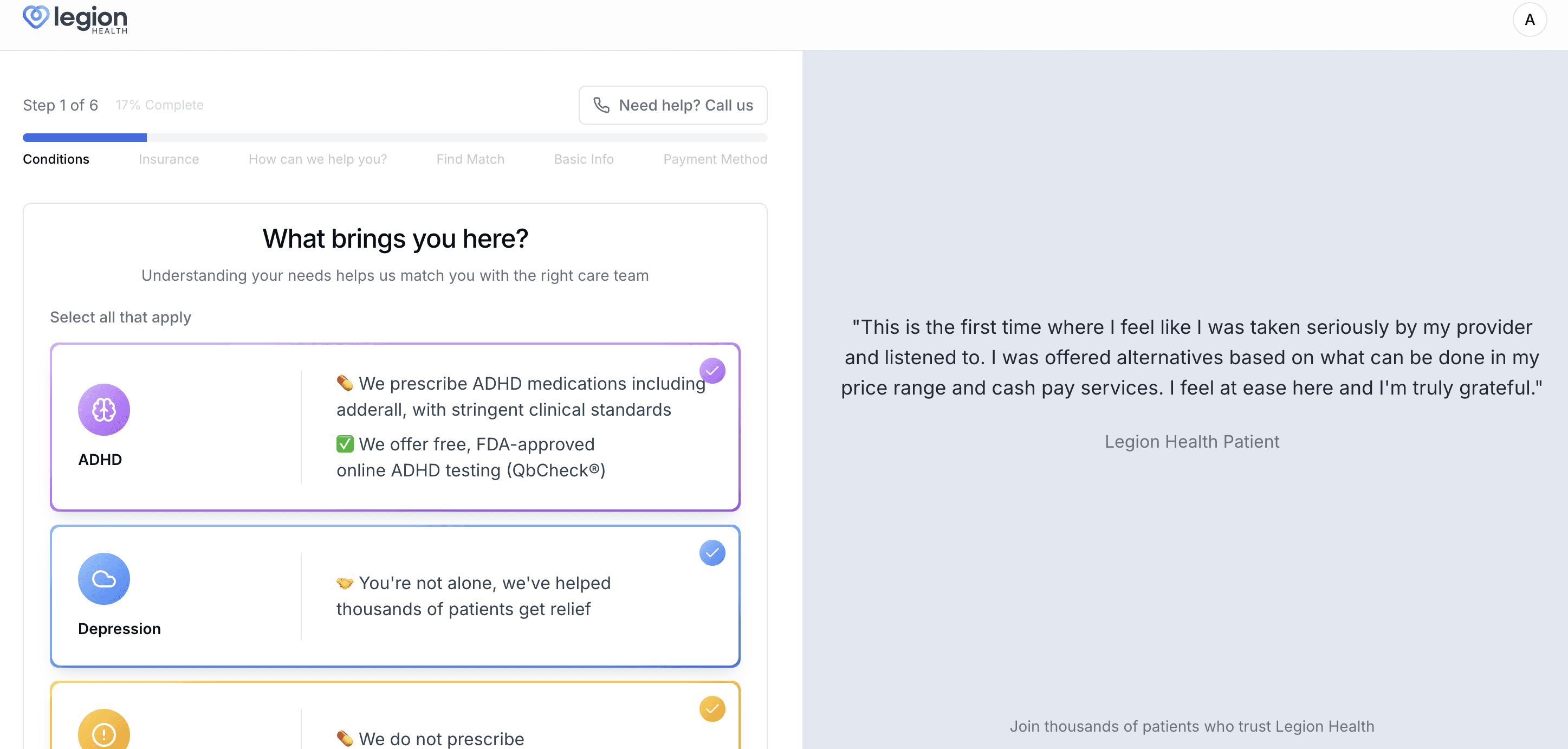
Circle Medical routes mental health care through primary care physicians. Legion Health provides care exclusively through board-certified psychiatric providers who specialize in mental health diagnosis and medication management.
We're also the only major telehealth provider offering free FDA-cleared objective ADHD testing. QbCheck provides supportive input to diagnosis and treatment monitoring, raising the floor on diagnostic rigor and offering a repeatable way to track change over time. Objective testing doesn't diagnose ADHD on its own, but Circle Medical relies solely on clinical interviews, which can miss objective patterns that testing reveals.
Circle Medical excludes bipolar disorder, schizophrenia, and complex PTSD. We treat the full range of outpatient psychiatric conditions, so you won't need to switch providers if your diagnosis changes or your needs become more complex.
Controlled substances are prescribed only when clinically appropriate and may require additional steps, documentation, and monitoring. If you want psychiatric specialists who accept insurance and provide objective testing, schedule a psychiatry visit. Your care is led by clinicians, not software.
Final Thoughts on Selecting Your Mental Health Care Provider
The difference between primary care mental health and psychiatric specialty care matters when you're managing ADHD, depression, or conditions that require focused expertise. Circle Medical serves a purpose, but you deserve to know what psychiatric providers with objective testing can offer compared to general practitioners managing mental health on the side. If anxiety, ADHD, or depression is affecting your life, schedule a psychiatry visit to make a plan.
This article is for informational purposes and is not medical advice. If you think you may have symptoms of a mental health condition, a psychiatric evaluation can help.
FAQs
Why would someone look for alternatives to Circle Medical?
Circle Medical uses primary care physicians to manage mental health conditions, which may not be ideal if you need specialized psychiatric care, objective ADHD testing, or treatment for complex conditions like bipolar disorder or PTSD that fall outside their scope.
When should you consider switching from Circle Medical to a psychiatry-focused service?
If you've tried multiple psychiatric medications without success, need treatment for conditions Circle Medical excludes (like bipolar disorder or complex PTSD), or want objective ADHD testing versus assessment based solely on clinical interviews, a specialized psychiatry service may be a better fit.
What should you look for when comparing telepsychiatry alternatives?
Focus on board-certified psychiatric providers over primary care physicians; check whether the service offers objective diagnostic testing (e.g., FDA-cleared QbCheck for ADHD); verify insurance acceptance; and confirm the service treats the psychiatric conditions versus excluding complex diagnoses.
How does provider type affect the quality of mental health care?
Board-certified psychiatric providers specialize exclusively in mental health diagnosis and medication management, while primary care physicians handle general health, with mental health as one of many areas where specialist training can make a meaningful difference for complex or treatment-resistant conditions.
We're honored to support thousands on their journeys. Here's what some have shared:

Really great experience. I got an appointment within a week and the doctor was really nice and professional and they scheduled my labs and everything in a timely manner. I was able to get them done locally and they reviewed them within the next 2 or 3 days with me over video conference. Really good experience!

Legion Health has been a great experience. Treat you like a person and design a custom plan to help your situation.

I’ve had a very positive and satisfying experience with Legion health and my provider, Blessing Ugbor. My needs have been met and my concerns have been addressed in a timely manner. I have been able to make contact easily and talk to real people 😊. I appreciate Legion Health for all the care and support I’ve received so far.

Really great and positive experience must try if you have been thinking about it

My first time using a teledoc. They simplified the process and my Dr. has been great. To say its been a great experience is an understatement. I highly recommend them.

They're great at communicating/meeting your needs
Related articles

Legion Health vs One Behavioral: Which is Better? (May 2026)
Legion Health vs One Behavioral (May 2026)
One Behavioral Reviews, Pricing, and Alternatives (May 2026)
One Behavioral Reviews & Alternatives May 2026

Being Health Reviews, Pricing, and Alternatives (May 2026)
Being Health Reviews & Alternatives May 2026