Dec 29, 2025
Mindbloom Reviews, Pricing, and Alternatives (December 2025)
Written by:

Arthur MacWaters
Co-Founder, Legion Health

You’ve been reading about ketamine therapy and wondering if Mindbloom is the right move. Before you pay over $1,000 for a six-session package, it makes sense to understand how it works and whether other options better fit your needs. This guide covers everything from Mindbloom reviews to pricing to how the at-home program actually operates. We also review five alternatives, including insurance-covered psychiatry for people who need medication management for conditions like anxiety, depression, or ADHD.
TLDR:
Mindbloom charges around $1,176–$1,290 for a six-session at-home ketamine program, with no insurance billing and patients paying out of pocket
Ketamine therapy is used for anxiety and depression and is not a solution for ADHD, bipolar disorder, or other conditions that require ongoing psychiatric medication management
Legion Health offers insurance-covered psychiatry in Texas, with board-certified clinicians, at typical copays of under $30 per visit
Legion Health accepts all major commercial insurance plans in Texas, provides objective ADHD testing (QbCheck) at no cost, and offers appointments within days as part of a broad psychiatric care model
What Is Mindbloom and How Does it Work?
Mindbloom focuses on at-home ketamine therapy aimed at anxiety and depression. Instead of daily maintenance medications, this approach uses dissolvable ketamine tablets to produce guided psychedelic experiences. The company operates across dozens of states in the US and has been described as delivering over 275,000 at-home ketamine therapy sessions annually across 36 states.
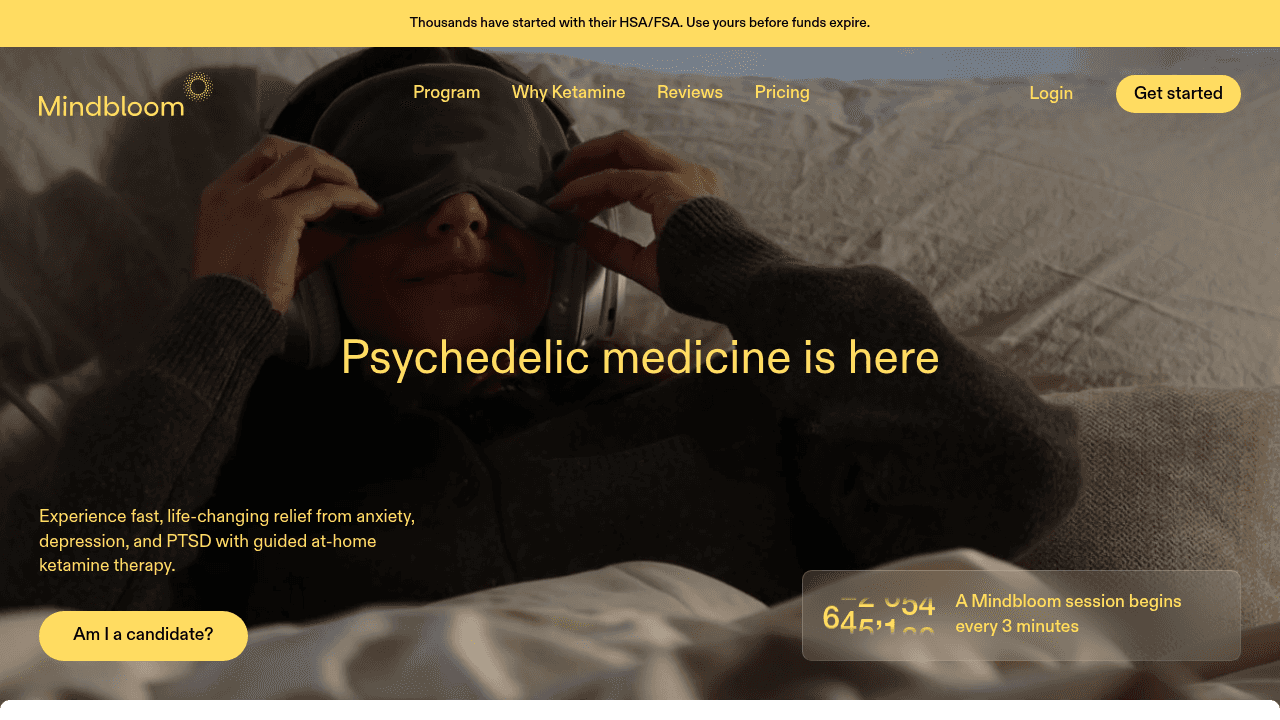
The initial six-session program includes a “Bloombox” with tools like a blood pressure cuff and eye mask. A psychiatric nurse practitioner manages prescribing, while a non-clinical “guide” helps with preparation and integration, and a “peer monitor” must be on-site during dosing sessions for safety.
Mindbloom charges around $1,176–$1,290 for a six-session at-home ketamine program. Mindbloom does not take insurance; patients pay directly, though some may use HSA/FSA funds or submit superbills to seek partial reimbursement from their insurer.
Why Consider Mindbloom Alternatives?
Mindbloom is designed for people who want psychedelic-assisted treatment and can manage a four‑figure out-of-pocket cost. The program does not bill insurance, requiring an upfront payment of roughly $1,176–$1,290 for a foundational six-session course, which can be higher per dose than some competitors, such as Innerwell, depending on promotions and program type.
The service is built around ketamine therapy for anxiety and depression, with limited support for ongoing medication management needs. It does not provide standard treatment pathways for ADHD, bipolar disorder, or other long-term conditions that typically require continuous monitoring and medication adjustments by a psychiatric provider.
Support relies heavily on “guides” and structured protocols, while one-on-one integration sessions with licensed clinicians can increase costs. Users have also reported concerns about delays and responsiveness in scheduling and follow-up, which can be frustrating for those expecting tightly coordinated care.
If you need insurance coverage, longitudinal psychiatric treatment, or help with ADHD or bipolar disorder, a conventional psychiatric provider is usually a better fit than a ketamine-only program.
Best Mindbloom Alternatives in December 2025
Legion Health (Best Overall Alternative)
Legion Health is a Texas-based virtual psychiatry service connecting patients with board-certified psychiatrists and psychiatric nurse practitioners. Unlike services that focus only on psychedelic interventions, Legion offers broad medication management for conditions such as anxiety, depression, ADHD, bipolar disorder, PTSD, and insomnia. As $41.59 billion market by 2032, with over 60% of mental health visits now conducted remotely in certain regions, virtual psychiatric care has become a mainstream, trusted option.
Key strengths and capabilities:
Insurance-friendly access: Legion Health accepts all major commercial insurance plans in Texas, covering about 95% of commercially insured Texans, with most patients paying under $30 per visit.
Fast scheduling: Appointments are usually available within days, including evening options, instead of the weeks-long waits often seen in traditional clinics.
Objective ADHD data: Legion uses QbCheck, an FDA-cleared digital ADHD assessment, in evaluations at no additional charge, giving clinicians measurable data alongside interviews.
Emphasis on safety: Medication plans, including those involving controlled substances, follow strict clinical protocols, with careful screening and ongoing monitoring.
Best suited for: Adults in Texas with commercial insurance who want affordable, evidence-based psychiatric care and medication management from licensed clinicians.
Bottom line: Mindbloom concentrates on cash-pay ketamine journeys, while Legion Health provides insurance-based psychiatry with a broader range of treatments. For most people seeking ongoing psychiatric care vs a psychedelic series, Legion is often the more practical, budget-conscious choice.
Talkiatry
Talkiatry is a large telepsychiatry practice that accepts various insurance plans and operates across multiple states. They connect patients with psychiatrists and nurse practitioners for medication management and evaluations.
What they offer: Virtual psychiatric care covered by many insurance networks.
Key limitation: Unlike Legion Health, Talkiatry does not offer objective ADHD diagnostic tools (such as QbCheck) as part of its standard intake. Patients may experience slower access, potentially resulting in longer wait times for initial visits compared to Legion's rapid scheduling.
Bottom line: Talkiatry is a viable option for general psychiatry across the U.S., but Legion Health provides faster access and objective ADHD testing data for Texas residents at no additional cost.
Cerebral
Cerebral operates on a subscription-based model, offering medication management and therapy services. They provide access to clinicians for conditions like anxiety, depression, and ADHD.
What they offer: A monthly subscription that bundles access to care and messaging.
Key limitation: Cerebral has faced regulatory scrutiny regarding prescribing practices in the past. Their subscription model often results in higher long-term costs compared to using insurance for per-visit copays at a practice like Legion Health. They also lack the objective ADHD testing protocols used at Legion.
Bottom line: While Cerebral offers a bundled subscription, Legion Health provides a more traditional, insurance-based medical model with rigorous clinical protocols and typically lower out-of-pocket costs.
Innerwell
Innerwell is a direct alternative for those seeking ketamine treatment. They offer at-home ketamine programs combined with therapy and psychiatric support.
What they offer: At-home ketamine treatments and EMDR therapy for trauma.
Key limitation: Innerwell is a niche. They focus on psychedelic therapy and do not offer general psychiatric medication management (such as mood stabilizers or standard ADHD medications) for broader mental health maintenance.
Bottom line: Innerwell is a strong competitor in the specific ketamine space. However, Legion Health is the better choice for patients needing ongoing medication management for daily mental health needs beyond psychedelic sessions.
Joyous
Joyous offers a very low-dose (microdose) ketamine protocol taken daily, as opposed to the macrodose sessions used by other providers.
What they offer: Subscription-based, low-dose ketamine lozenges delivered by mail.
Key limitation: This is a "protocol-based" subscription instead of personalized psychiatric care. It is not suitable for patients who need standard medication management for complex conditions like bipolar disorder or ADHD.
Bottom line: Joyous is a low-cost, entry-level option for microdosing ketamine, but it lacks the complete clinical oversight and full-range psychiatric treatment available at Legion Health.
Feature Comparison: Mindbloom vs Top Alternatives
Choosing a mental health provider often comes down to specific needs regarding insurance coverage, budget, and the type of care required. While Mindbloom focuses exclusively on ketamine therapy for a cash-pay fee, other options offer psychiatric medication management covered by insurance.
For example, Legion Health accepts major commercial insurance plans in Texas and includes objective ADHD testing (QbCheck). The comparison below showcases the differences in cost, clinical focus, and availability across these services.
Feature | Mindbloom | Legion Health | Talkiatry | Cerebral | Innerwell | Joyous |
|---|---|---|---|---|---|---|
Insurance Accepted | No | Yes (all major commercial plans in TX) | Yes (selective networks) | No (subscription) | Yes (some plans) | No |
Board-Certified Providers | Yes (for prescribing) | Yes | Yes | Nurse practitioners only | Yes | Nurse practitioners |
Treatment Approach | Ketamine therapy only | Extensive psychiatric medication management | Extensive psychiatric medication management | Medication management + therapy | Ketamine therapy + therapy | Ketamine microdosing |
ADHD Medication Management | No | Yes | Yes | Yes (limited) | No | No |
Objective ADHD Testing | No | Yes (QbCheck, free) | No | No | No | No |
Conditions Treated | Depression, anxiety | Depression, anxiety, ADHD, bipolar, PTSD, insomnia, more | Depression, anxiety, ADHD, bipolar, more | Depression, anxiety, ADHD, insomnia | Depression, anxiety, PTSD | Depression, anxiety, PTSD |
Primary Care Coordination | Limited | Yes | Limited | No | Limited | No |
Availability | 36 states | Texas only | Multiple states | Multiple states | 25 states | Multiple states |
Why Legion Health is the Best Mindbloom Alternative
Mindbloom occupies a specific niche for people who can afford high out-of-pocket costs and who are pursuing psychedelic-assisted therapy. For those seeking longer-term mental health care with insurance coverage, Legion Health is often a more practical and sustainable option. Unlike Mindbloom's cash-pay model, Legion Health accepts all major commercial insurance plans in Texas, which covers about 95% of commercially insured Texans.

While Mindbloom focuses on ketamine sessions, Legion offers evidence-based medication management for conditions like ADHD, anxiety, and depression, delivered by board-certified psychiatric clinicians. Legion also uses QbCheck, an FDA-cleared ADHD assessment, to add objective data to its diagnostic process at no extra cost to patients.
Final Thoughts
Deciding between these services largely depends on whether you want a guided psychedelic protocol or traditional psychiatric care that works with your insurance. Mindbloom is a specialized option for at-home ketamine therapy, but it operates entirely outside standard insurance billing and requires substantial cash payment. For people in Texas who need ongoing support for anxiety, depression, or ADHD, an insurance-based psychiatric model can make more sense both clinically and financially. Legion Health offers an insurance-aligned path for Texas residents. You meet with board-certified psychiatric clinicians who review your overall medical context instead of focusing on a single treatment modality, and you gain access to structured follow-up and objective testing tools like QbCheck for ADHD. Because Legion works with most major health plans in Texas, the long-term cost of care is typically much lower than cash-pay ketamine programs.
FAQs
When should you consider looking for alternatives to Mindbloom?
If you need ongoing medication management for conditions beyond anxiety and depression, or insurance-covered depression treatment for ADHD or bipolar disorder, alternatives like Legion Health may be a better fit.
What should you look for when comparing ketamine providers to traditional psychiatry services?
Consider whether you need a one-time psychedelic experience or ongoing medication management for daily symptoms. Traditional telepsychiatry services accept insurance and treat a broader range of conditions, while ketamine providers typically require upfront payment and focus on specific protocols vs broad-based care.
How do insurance-based psychiatry services differ from cash-pay ketamine programs?
Insurance-based services like Legion Health typically cost less than $30 per visit (your copay) and provide ongoing medication management by board-certified clinicians. Cash-pay ketamine programs like Mindbloom charge $1,176–$1,290 upfront for a fixed number of sessions and do not accept insurance.
Can you get ADHD treatment through ketamine therapy providers?
No. Ketamine providers like Mindbloom, Innerwell, and Joyous focus on ketamine protocols for anxiety, depression, or PTSD. They do not prescribe standard ADHD medications or provide medication management for ADHD, bipolar disorder, or other conditions requiring ongoing psychiatric care
We're honored to support thousands on their journeys. Here's what some have shared:

Really great experience. I got an appointment within a week and the doctor was really nice and professional and they scheduled my labs and everything in a timely manner. I was able to get them done locally and they reviewed them within the next 2 or 3 days with me over video conference. Really good experience!

Legion Health has been a great experience. Treat you like a person and design a custom plan to help your situation.

I’ve had a very positive and satisfying experience with Legion health and my provider, Blessing Ugbor. My needs have been met and my concerns have been addressed in a timely manner. I have been able to make contact easily and talk to real people 😊. I appreciate Legion Health for all the care and support I’ve received so far.

Really great and positive experience must try if you have been thinking about it

My first time using a teledoc. They simplified the process and my Dr. has been great. To say its been a great experience is an understatement. I highly recommend them.

They're great at communicating/meeting your needs
Related articles

Legion Health vs One Behavioral: Which is Better? (May 2026)
Legion Health vs One Behavioral (May 2026)
One Behavioral Reviews, Pricing, and Alternatives (May 2026)
One Behavioral Reviews & Alternatives May 2026

Being Health Reviews, Pricing, and Alternatives (May 2026)
Being Health Reviews & Alternatives May 2026